Note: This article documents a personal trial and setup plan on my own modified Honda XR BAJA (MD30). Because carb settings depend heavily on individual intake and exhaust modifications, this does not guarantee identical results on other XR250 series motorcycles.
"Can I sharpen throttle response and low-end torque while keeping the stock carburettor?"
"Is there a way to achieve cleaner fuel combustion when jetting an older vintage bike?"
Few things match the visceral single-cylinder pulse of my beloved Honda XR BAJA (MD30).
At present, my BAJA features significant intake and exhaust upgrades, running the following setup:
- Air Cleaner: K&N high-flow air filter
- Intake Duct: High-flow connecting tube from the competition-only ME08 (XR250R)
- Exhaust Header: MUGEN header pipe
- Silencer: BEAMS titanium exhaust
With both intake airflow and exhaust scavenging substantially upgraded, the bike runs brilliantly. However, compared to modern electronic fuel injection (EFI) machines, carburettors inevitably display occasional hesitations upon sudden throttle opening and slight sluggishness in the lower-to-mid rev range—moments where the coarseness of fuel atomisation becomes apparent.
In the midst of addressing this, I managed to acquire a used set of a legendary Japanese carburettor tuning package I had long wanted to try: the KENSO Bakudan Kit!
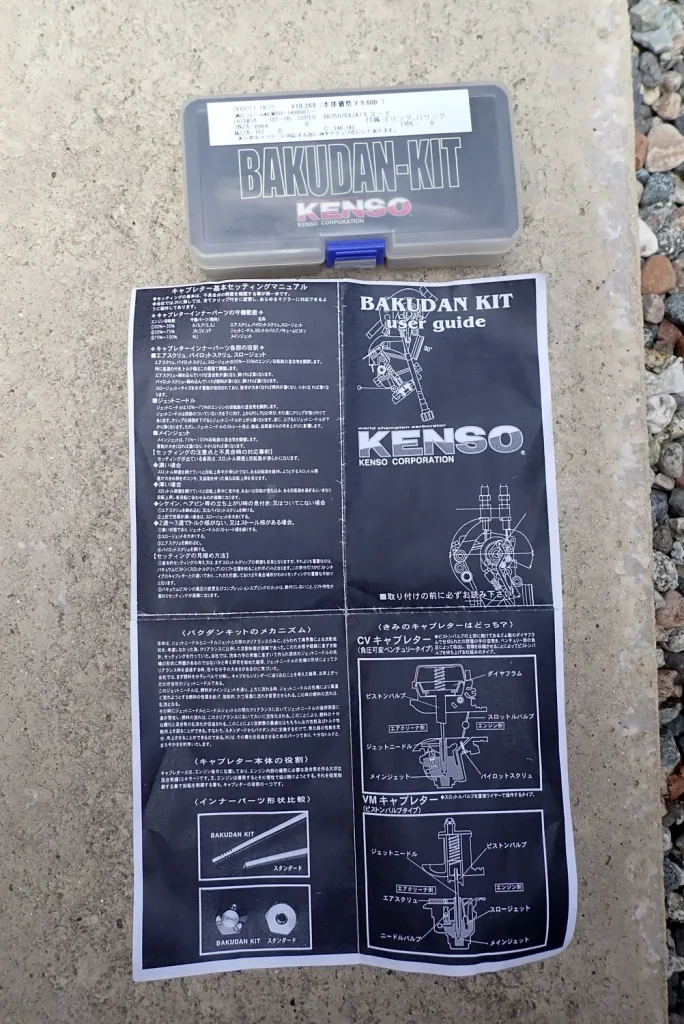
The original developer, KENSO, has long since closed down, making this a discontinued, out-of-production part that cannot be purchased new today.
Because this package was bought second-hand, the proprietary jet needle that originally came with the kit was missing, and only a select few main jet sizes were included. However, inspecting the main jets under a magnifying glass and a macro lens revealed an uncompromising degree of micro-machining that clearly operates in a different league from standard jets.
In this article, I will cover the fundamentals of fuel atomisation in carburettors, inspect the remarkable engineering behind the Bakudan Kit, and detail my upcoming installation plan for the XR BAJA!
1. Carburettor Fundamentals: Why Is Fuel Atomisation Crucial?
Before dissecting the structure of the Bakudan Kit, let us review the operating principle of how a carburettor creates the air-fuel mixture.
Liquid Petrol Does Not Burn Directly!
Although petrol (gasoline) fuels our engines, liquid fuel itself will not ignite explosively simply by introducing an electrical spark.
To burn completely and efficiently, the fuel's contact surface area with oxygen must be maximised by breaking it into a fine aerosol mist. This process is known as atomisation.
Operating Principle and the Venturi Effect
A carburettor operates on the Venturi effect (Bernoulli's principle), where fluid pressure decreases as air velocity increases.
- As the piston moves downward on the intake stroke, strong negative pressure draws air at high speed through the carburettor's narrow passage (the venturi).
- Constricting the airflow passage accelerates velocity, causing air pressure at the narrowest point to drop below atmospheric pressure.
- Atmospheric pressure acting on the fuel inside the float bowl (float chamber) forces petrol up through the main jet and discharge nozzle into the venturi.
- Colliding with the high-speed airstream shears the liquid petrol into tiny droplets, carrying the mist into the combustion chamber.
Limitations of Stock Carburettors: What Happens When Mist Is Coarse?
Even though fuel discharged from a standard main jet may look like a fine spray to the naked eye, a significant percentage actually travels as relatively large fuel droplets when viewed at the microscopic combustion engineering level.
- Drawbacks of large fuel droplets: Oxygen cannot reach inside the droplet core quickly enough, slowing the flame propagation speed. This results in pumping losses, sluggish throttle pickup, incomplete combustion (producing black soot and carbon deposits), and reduced fuel economy.
- Benefits of finer atomisation: Microscopic fuel droplets vaporise instantly via intake air heat, promoting rapid, complete combustion when sparked by the plug. Engine transient response becomes markedly sharper, accompanied by beefier torque across the entire rev range.
Pouring intense dedication exclusively into shattering fuel particles into the finest achievable aerosol is the foundational philosophy behind KENSO's Bakudan Kit.
2. What Was the Legendary KENSO Bakudan Kit?
The Bakudan Kit was a dedicated carburettor tuning kit developed and marketed by KENSO Co., a renowned tuning shop formerly based in Kanagawa Prefecture, Japan, led by Kenzo Kaminaga.
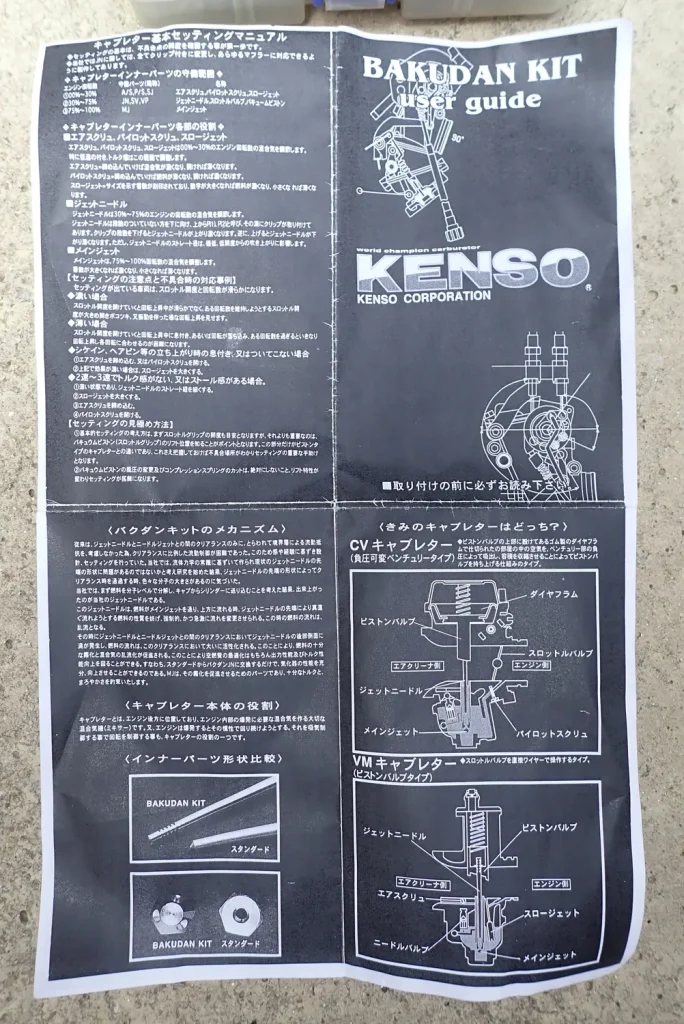
Throughout the 1990s and 2000s, this iconic product was an absolute staple in Japanese motorcycle magazine features and custom build showcases.
Why Was It Named "Bakudan" (The Bomb)?
The aggressive moniker "Bakudan" (meaning "bomb" or "explosive" in Japanese) might suggest a crude racing kit that simply dumps excess fuel to force out more horsepower.
In reality, its engineering philosophy was the exact opposite: an exquisitely calculated fluid-dynamics upgrade designed to maximise combustion efficiency and explosive force strictly through ultra-fine fuel atomisation.
Without requiring an expensive flat-slide racing carburettor (such as a Keihin FCR or Mikuni TMR costing hundreds or thousands of pounds), riders could retain the smooth rideability and cold-start reliability of their stock constant-velocity (CV) vacuum carburettor while unlocking razor-sharp throttle response and enhanced power. This concept earned passionate support from weekend mechanics and long-distance tourers alike.
Today, KENSO has unfortunately closed its doors, making it impossible to buy brand-new kits. The only way to find one is by scouring Japanese online auctions or flea-market platforms for surviving deadstock or well-preserved second-hand units.
3. [Close-Up Inspection] How Do Bakudan Main Jets Differ from Standard Jets?
I took macro photographs to closely examine the main jets included with this used kit.
When placed side-by-side with conventional main jets (whether OEM or standard aftermarket replacements), the craftsmanship is astonishing.
Difference 1: Precision Chamfering on Sub-1mm Inlet Orifices
The first detail that caught my eye was the bottom inlet face of the main jet—where fuel is initially drawn from the float bowl.
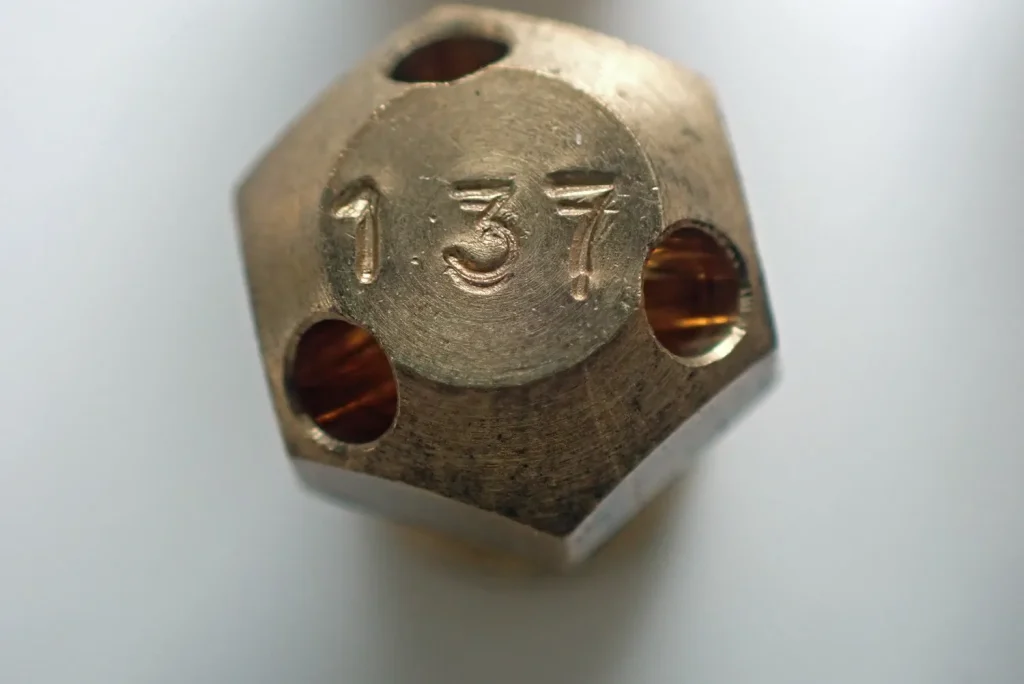
On typical main jets, the inlet hole is merely drilled straight through, leaving a sharp, 90-degree right-angled edge.
In stark contrast, the Bakudan main jet features an exceptionally smooth, uniform chamfer along the perimeter of an orifice measuring well under 1 mm in diameter.
In fluid dynamics, when a liquid enters a sharp-edged orifice, fluid detachment creates a swirling recirculation zone known as vena contracta. This constricts the effective flow area and produces substantial hydraulic drag (pressure drop). By creating a funnel-like chamfer, fuel enters smoothly without turbulence, allowing immediate, linear fuel delivery even under minute negative-pressure changes.
Difference 2: Tapered Diffuser Bore on the Needle Side
Next, let us inspect the upper discharge side facing the venturi, where the jet needle sits.
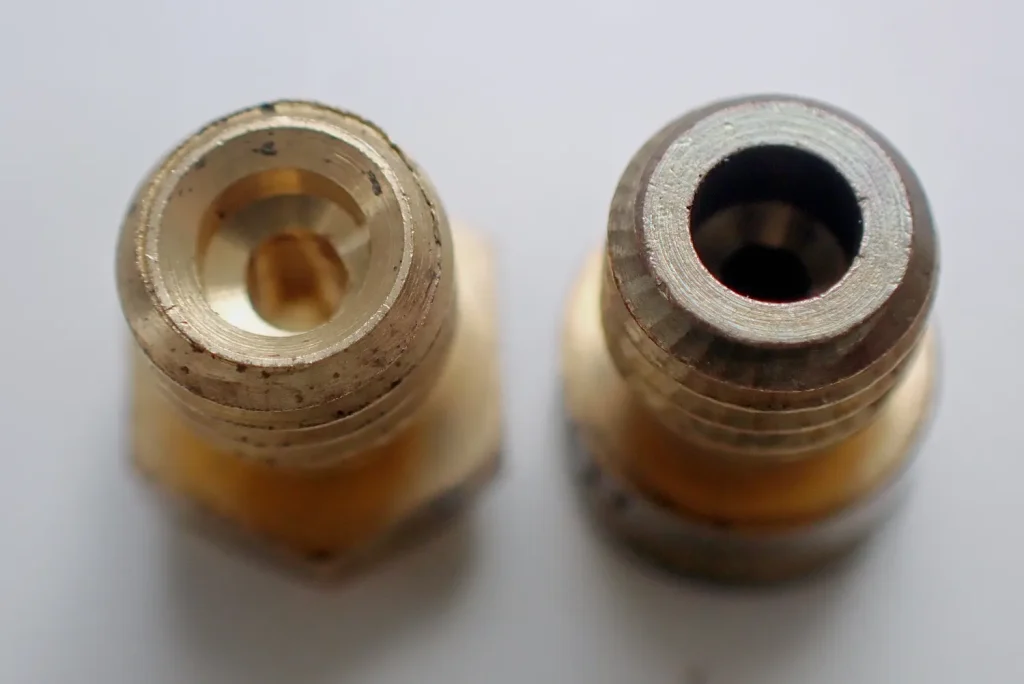
While standard jets feature a straight cylindrical bore, the inner wall of the Bakudan jet features a trumpet-shaped tapered bore widening toward the outlet.
This diffuser profile creates an abrupt pressure gradient and velocity differential right where fuel meets the passing airstream. As a result, the drawn fuel is aggressively sheared into an ultrafine aerosol mist and dispersed evenly in all directions.
What looks like a simple slotted brass bolt from the outside is, in truth, an exceptionally engineered precision nozzle governing fluid dynamics.
4. The Reality of Used Kits & Installation Plan for the XR BAJA (MD30)
Checking the main jet sizes included in this second-hand set confirmed four distinct ratings:
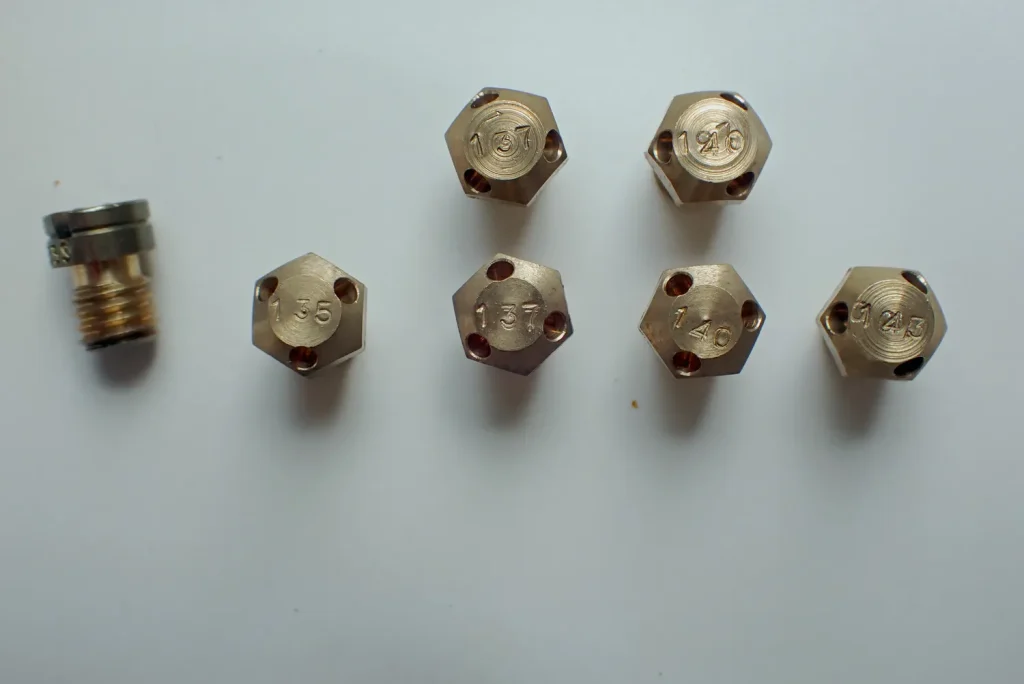
The Second-Hand Hurdle: Missing Proprietary Jet Needle
In its original complete form, the Bakudan Kit delivers 100% of its designed capability only when paired with its custom multi-taper jet needle, which maintains precise annular clearances with the jet.
Unfortunately, the proprietary needle was not included with this used purchase.
You might wonder whether running the jet without its matched needle defeats the purpose. However, as demonstrated above, the chamfered inlet and tapered exit bore on the Bakudan main jet alone unquestionably improve fuel atomisation.
Compatibility with My XR BAJA Intake/Exhaust Setup
My XR BAJA (MD30) runs a high-efficiency breathing package: K&N air filter, ME08 intake connecting tube, MUGEN header, and BEAMS titanium silencer.
- OEM Baseline Jet Size: Around #138 (varies slightly depending on model year/market specification)
- Modified Jetting Rule of Thumb: With enhanced airflow and scavenging, standard tuning practice requires stepping up main jet sizes to prevent leaning out at high RPM.
The sizes available in this kit (#135 to #143) fall squarely within the ideal tuning window for testing on this high-flow setup.
My plan is to combine the Bakudan main jet with the stock needle—adjusting needle clip heights as needed—to test how top-end over-rev and midrange roll-on torque are affected.
Removing the carburettor and accessing the float bowl takes deliberate workshop time, so the on-road testing will happen down the road. Still, simply studying these precision brass components on the garage workbench is pure bliss for any carburettor enthusiast.
5. Summary: Carburettor Wisdom from a Lost Masterpiece
While modern bikes rely on ECUs and high-pressure fuel pumps to inject metered fuel, there is timeless romance in carburettors—drawing fuel purely via negative pressure and air velocity, achieving microscopic atomisation through mechanical geometry alone.
- Reduced hydraulic resistance via chamfered sub-1mm orifices
- Ultrafine fuel misting via tapered diffuser nozzle architecture
- KENSO's visionary design philosophy, remaining brilliant decades later
Despite missing the proprietary needle, I look forward to methodically tuning the XR BAJA by testing these Bakudan main jets.
Once I pull the carb apart and install the jets, I will report back with spark plug colour readings and riding impressions!
Workshop Note: When servicing carburettors, a high-quality aerosol cleaner such as Yamalube Super Carburettor Cleaner is invaluable for clearing varnish and emulsified deposits from internal passages.
Disclaimer
*The technical explanations, component interchange observations, and tuning plans described in this article are based solely on the author's personal experience and technical opinions. Disassembling and tuning carburettors can significantly impact engine performance, exhaust emissions, and engine longevity (including risk of seizure). Always consult the official workshop service manual and proceed entirely at your own risk.
Note on Sourcing Discontinued Japanese Tuning Parts:
The KENSO Bakudan Kit discussed in this article was produced by a Japanese tuning company that is no longer in business. New kits are no longer produced or sold. Surviving examples occasionally appear on Japanese domestic online auctions (such as Yahoo! Auctions Japan) or flea-market platforms (such as Mercari). Because these domestic platforms generally do not offer international shipping, overseas enthusiasts seeking these parts typically need to use a Japanese proxy purchasing or freight forwarding service.