In this article, we’ll be pulling the front fork springs from three of Honda’s iconic dual-sport and off-road machines—the XR250 (MD30), the XR BAJA, and the competition-only XR250R (ME08)—to perform a thorough side-by-side comparison of their specs, free length, and internal structures. We’ll also dive deep into the "model-year trap" hidden within the factory service manuals regarding subtle spec changes over the years.
Hey everyone! Today, we’re doing a deep dive into the suspension setup of the Honda XR series, a lineup that still commands a massive cult following among off-road enthusiasts.
Right now, I have three different sets of front forks on my workbench: the street-legal XR250 (MD30), the XR BAJA, and the pure racer XR250R (ME08). I’ve previously broken down the structural differences between the street-legal MD30 and the competition-spec ME08 forks in an earlier comparison post. If you haven’t read that yet, make sure to check it out first.
▼ Related Article: The Crucial Differences Between XR250 (ME08) and (MD30) Front Forks
This time, we’re taking it a step further. I wanted to answer a burning question: "Since the XR BAJA carries a lot of extra weight upfront due to its massive dual-headlight assembly compared to the standard XR250, wouldn't the internal fork springs be completely different too?" To find out, I tore them down, measured the springs, and compared them side-by-side.
1. Visual and Structural Differences in Front Fork Springs Across the Three Models
First, let’s lay out the springs extracted from each front fork for a side-by-side comparison. (Pro tip: Place a few socket wrenches as stoppers to keep the springs from rolling around during measurement).
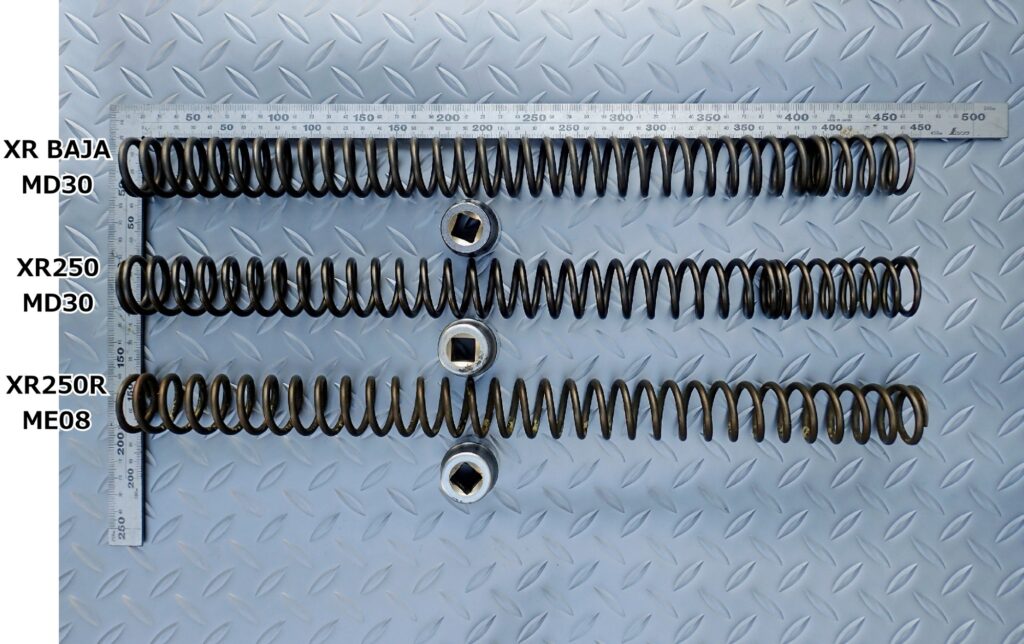
[Image 1: Complete front fork spring sets for the XR BAJA (MD30), XR250 (MD30), and XR250R (ME08), arranged from top to bottom]
At first glance, they might look identical, but there’s a clear variance of about 5mm in overall length between each model. However, the biggest structural difference lies in the number of spring segments.
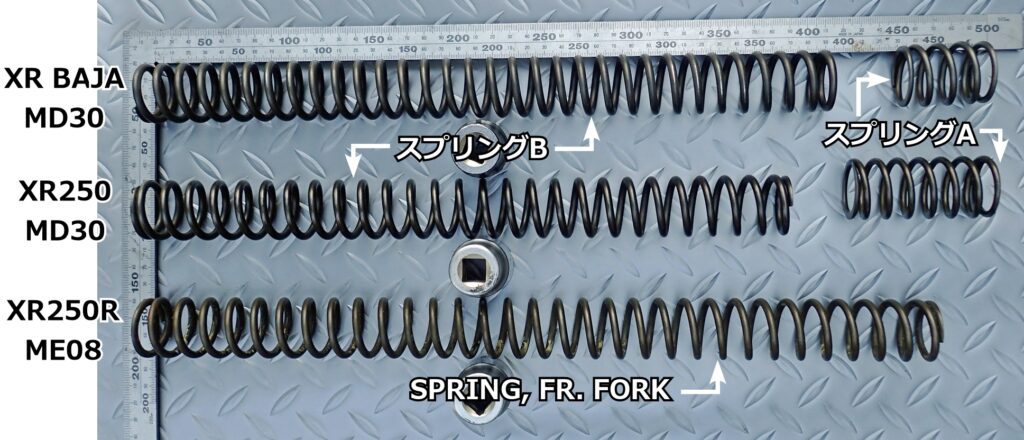
[Image 2: Comparison of spring configurations; XR250 and BAJA feature a two-piece design, while the XR250R uses a single, continuous spring]
■ Model-by-Model Spring Configuration Comparison
- XR250 (MD30) & XR BAJA: These models utilize a two-piece setup, combining two springs of different lengths—a short "Spring A" and a long "Spring B."
- XR250R (ME08): This competition-spec model features a single-piece setup (a continuous single spring) with no division.
According to the official factory parts catalog, the shorter spring used in the MD30 series is designated as "Spring A," and the longer one as "Spring B." As suspected, the XR250 and XR BAJA—which carry significantly different front-end weights—do indeed run distinctly different spring setups.
2. [Actual Data] Free Length Measurement Results for Each Spring
Here are the actual free length (uncompressed overall length) measurements, taken using a precision straight-edge ruler. I’ve put them into a clean mobile-friendly table so you can digest the numbers at a glance.
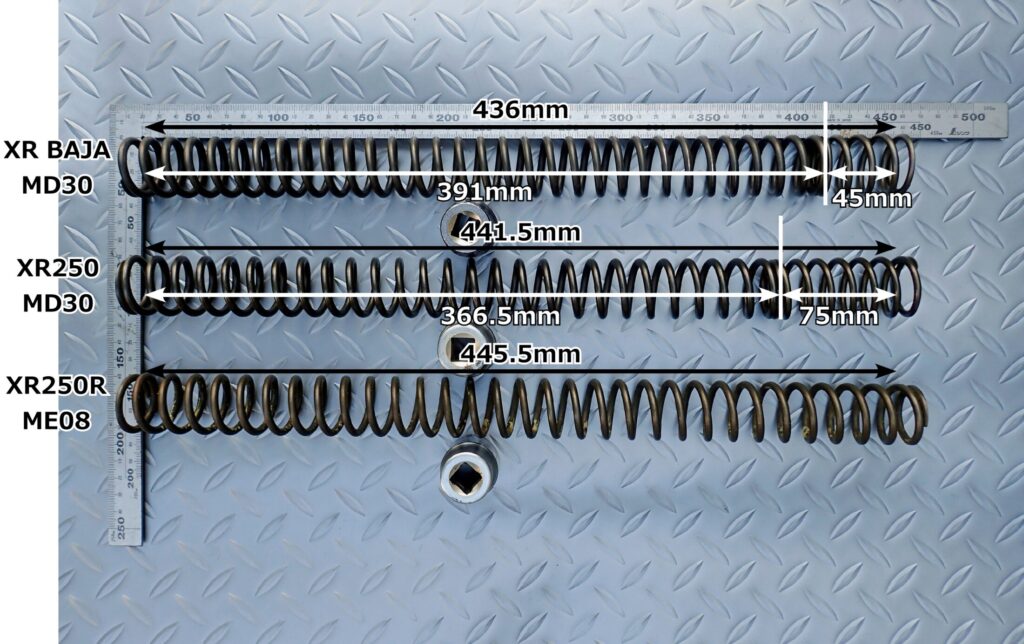
[Image 3: Comparison image showing measured values, visualizing the length of each spring in millimeters]
| Model / Frame Code | Spring A (Short) | Spring B (Long) | Total Spring Length |
| XR BAJA (MD30) | 45.0 mm | 391.0 mm | 436.0 mm |
| XR250 (MD30) | 75.0 mm | 366.5 mm | 441.5 mm |
| XR250R (ME08) | - (None) | - (None) | 445.5 mm |
The actual measurements revealed that the ratio between Spring A and Spring B differs drastically between the standard XR250 and the XR BAJA. On the BAJA, the short Spring A is significantly shorter (45.0 mm), while the long Spring B is much longer (391.0 mm).
On the flip side, the race-spec ME08 relies on a single 445.5 mm spring. This tells us that its preload and overall running gear characteristics are designed on a completely different philosophy.
3. Factory Service Manual Specs and the "Model-Year Trap"
When I tried cross-referencing my real-world measurements with the "Standard Free Length" and "Service Limit" listed in the official Honda service manual, I hit an incredibly interesting snag. This is where a major "model-year trap" lies waiting for anyone doing DIY maintenance or swapping secondhand parts.
① Base Service Manual Data (Early-Model XR250)
The baseline specs listed in the main "Service Information" section of the manual were as follows:
- Spring A: Standard 72.9 mm (Service Limit: Replace if 72.2 mm or less)
- Spring B: Standard 363.1 mm (Service Limit: Replace if 359.5 mm or less)
These numbers align relatively well with my actual measurements for the XR250 (MD30) (A: 75.0 mm / B: 366.5 mm). Allowing for minor manufacturing tolerances, aging, or slight variations in measuring technique, they are practically a match.
② "XR BAJA (T-Model) Supplement" Data
However, when I flipped to the T-model supplement pages to verify the BAJA data, I found some completely unexpected numbers:
- Spring A: Standard 64.8 mm (Service Limit: 64.2 mm)
- Spring B: Standard 374.4 mm (Service Limit: 370.7 mm)
These numbers are completely different from the actual BAJA spring measurements sitting on my bench (A: 45.0 mm / B: 391.0 mm).
③ "XR250 / XR BAJA (V-Model) Supplement" Data
Digging further into the manual, I uncovered another set of data in the V-model supplement section:
- XR250 Spring A: Standard 44.1 mm (Service Limit: 43.7 mm)
- XR250 Spring B: Standard 391.8 mm (Service Limit: 387.9 mm)
【The Big Reveal】
The V-model supplement specs for the standard XR250 (A: 44.1 mm / B: 391.8 mm) are almost a perfect match for the physical measurements I took from my XR BAJA springs (A: 45.0 mm / B: 391.0 mm).
What does this mean? It means the front fork springs in the XR series weren't just differentiated by model (Standard vs. BAJA), but their dimensions were completely overhauled depending on the specific model year (minor change codes).
4. Unlocking Honda's Chassis Engineering via the Official FactBook
To unravel this mystery, I dug into Honda’s official archive, the "FactBook." It turns out that Honda executed incredibly precise updates to the XR series' suspension and chassis engineering with almost every model year.
For instance, on the 1996 XR BAJA, the suspension stroke was shortened by 5mm compared to the standard XR250, and the caster angle was kicked out slightly. This was a dedicated design choice clearly aimed at improving straight-line stability and ride comfort (cushion compliance) to offset the extra front-end weight of the BAJA's massive dual-headlight setup.
Therefore, these variations in spring length aren't just random production tolerances—they represent the history of suspension tuning that Honda pursued for each model year and variant. Given these findings, there’s an extremely high probability that the internal damper cartridges themselves have different specifications as well.
5. Summary and What’s Coming Next
To wrap things up, here are the three key takeaways from this teardown:
- Structural Differences: The XR250 and XR BAJA utilize a two-piece spring setup, whereas the race-only XR250R (ME08) relies on a single continuous spring.
- The Model-Year Factor: Spring lengths for the XR250 and BAJA vary drastically not just between the models themselves, but across different production years and model codes.
- Parts-Swapping Risk: When rebuilding forks or buying secondhand parts, you must strictly verify the specific model year (e.g., T-model, V-model). Mixing them up can seriously throw off your suspension balance.
I initially set out to write a simple post showing that "these three models have different springs," but the investigation exposed a much deeper rabbit hole of year-by-year revisions. In the next post, we’re going to dive even further into how the OEM part numbers evolved in the parts catalog and check out the structural differences in the damper cartridges. Stay tuned!
Update: December 27, 2025 I’ve put together a comprehensive summary of the front fork spring differences based directly on the official service manual.
🔧 Essential Gear for Front Fork Maintenance & Overhauls
Keeping your XR series forks performing at their peak requires regular oil changes and fresh seals. Here is the essential Honda OEM gear and recommended parts you'll need to tackle this job in your home garage.
- Honda OEM Ultra CO Cushion Oil (Fork Oil): The factory-specified fluid. This is an absolute must-have item to maintain the baseline damping characteristics intended by the engineers.
- Honda OEM Oil Seal & Dust Seal Set (for MD30/ME08): The ultimate repair parts when you start seeing fork oil leaks. I highly recommend sticking with high-quality, reliable OEM seals over cheap aftermarket options.
- Honda XR250 Factory Service Manual & Parts Catalog: Your absolute bible for ensuring precise torque specifications, tracking down correct model-year numbers, and performing trouble-free garage maintenance.