Honda XR250 & XR BAJA (MD30) Model Years: Which One to Buy Used
Honda's air-cooled off-roaders, the XR250 and XR BAJA. The MD30 generation arrived in 1995, and Honda kept updating it over the years. In 2003, for example, the XR250 got upside-down forks. If you are buying one secondhand, which model year should you choose?
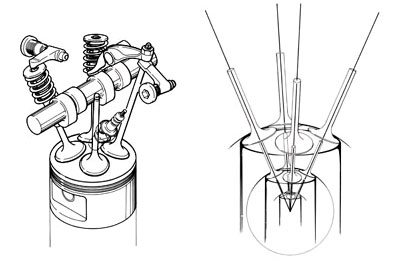
In this article I cover the RFVC engine, the equipment that only the BAJA has, the differences between conventional and upside-down forks, the changes in each model year (based on Honda's press releases), and the points to check when choosing a used bike.
It is a long article, so feel free to read only the parts you are interested in.
I own a 2000 XR BAJA myself. I bought it secondhand around 2008, when it had 33,000 km on the odometer.
Which bikes does this cover? This article is about the MD30 XR250 and XR BAJA, which Honda sold in Japan from 1995. They are different models from the XR250R (ME08) and the XR250L sold in North America. The year-by-year changes are based on Honda Japan's press releases, and the colours and specifications are for Japanese-market bikes.
1. Why the Honda XR250 / BAJA Is Still Popular, and the Used Market Today
The Appeal of the Air-Cooled Four-Stroke RFVC Engine
The RFVC engine in the XR250 and BAJA is Honda's air-cooled single with four radially arranged valves. It has the pulse you expect from an air-cooled single, and it revs up freely. The cooling fins of an air-cooled engine also look good.
Unlike a quiet water-cooled engine, it lets you really feel the engine as you ride. I think this is why so many fans still love it.
The XR250 and XR BAJA share the same basic design, but they have different characters. The XR250 has a light front end and feels nimble on trails and in town. The BAJA, on the other hand, has large twin headlights and is a touring-oriented model.
If you want a light, nimble bike for off-road riding, I think the XR250 suits you. If you mainly want to tour, the BAJA is a better match. Choose the one that fits how you ride.
Why Choose a Used MD30 XR250 Today?
One reason to choose an MD30 XR250 today is its light weight. The dry weight is in the 110 kg range (115 kg for the XR250 at its 1995 launch and 119 kg for the 2003 model), which is easy to handle even on trails.
It is also air-cooled and simply built, so it is easy to maintain yourself. That is a real plus if you want to keep riding it for a long time. Aftermarket parts and used parts are also available.
A Long-Running Model: 1995 to 2007
The MD30 XR250 series was launched in 1995 and sold for 12 years, up to the 2007 model. The XR250 had conventional forks at first, but it switched to upside-down forks in the 2003 model change.
The BAJA was also updated, for example with a larger 14 L fuel tank in 1996. Because the bikes were sold for so long, you can still find used parts and aftermarket parts today.
Why It Is Hard to Find a Good Used Bike
Production ended a long time ago, and bikes in good condition are getting rare. Even if a bike looks clean, there may be problems you cannot see from the outside, such as a frame bent by off-road riding or a worn engine.
In particular, take a close look at cracks in the frame and how the suspension moves. Rather than low mileage, I think it is better to focus on whether the oil and consumables have been changed properly, in other words the maintenance history.
2. How the XR250 / BAJA Changed Over the Years
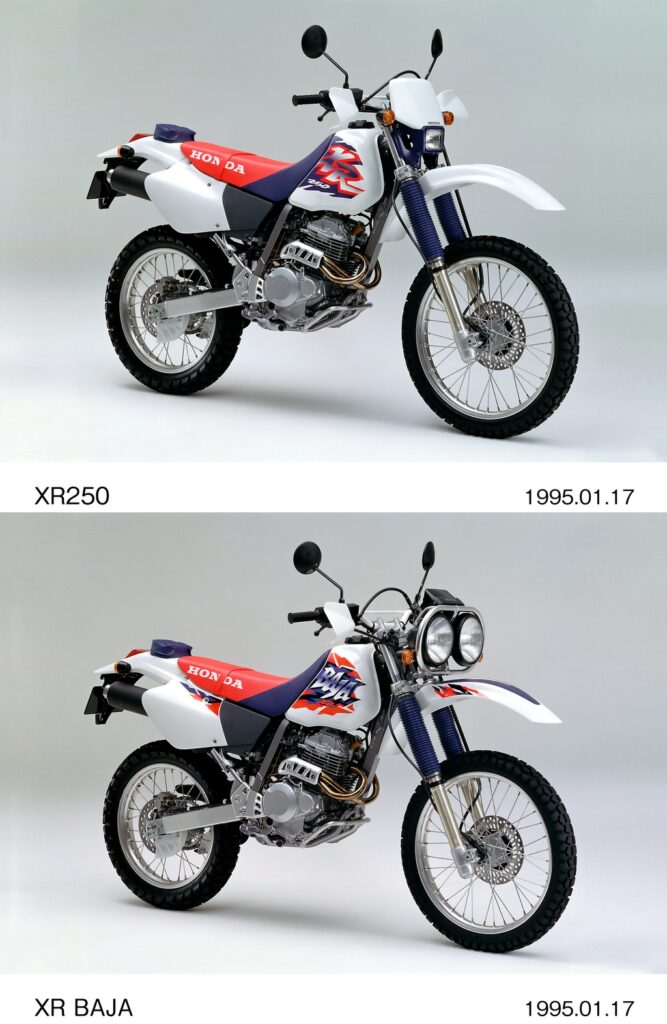
1995: The MD30 at Launch
One feature of the MD30 XR250 launched in 1995 is its dry-sump system, which uses part of the frame as the oil tank. This keeps the engine compact. It also came with an electric starter as standard, which makes it easier to restart after a stall on rough ground (from Honda's press release).
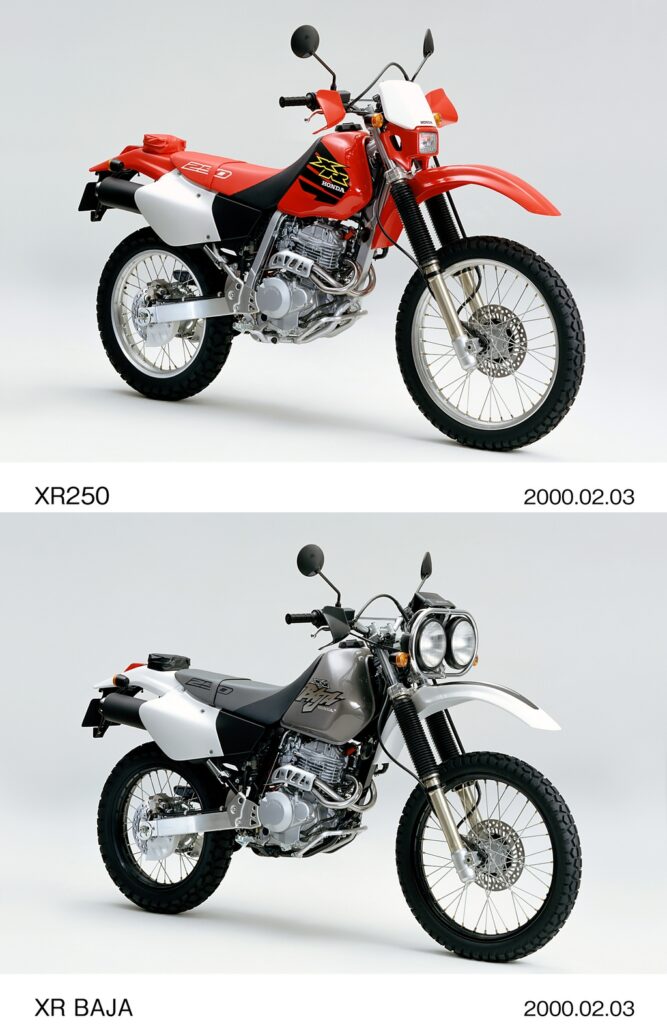
The BAJA has large twin headlights, each 150 mm in diameter, mounted on the frame, which keeps weight off the handlebars. The BAJA name was carried over from the earlier XLR BAJA.
1996–1998: A Bigger Tank for the BAJA and New Colours
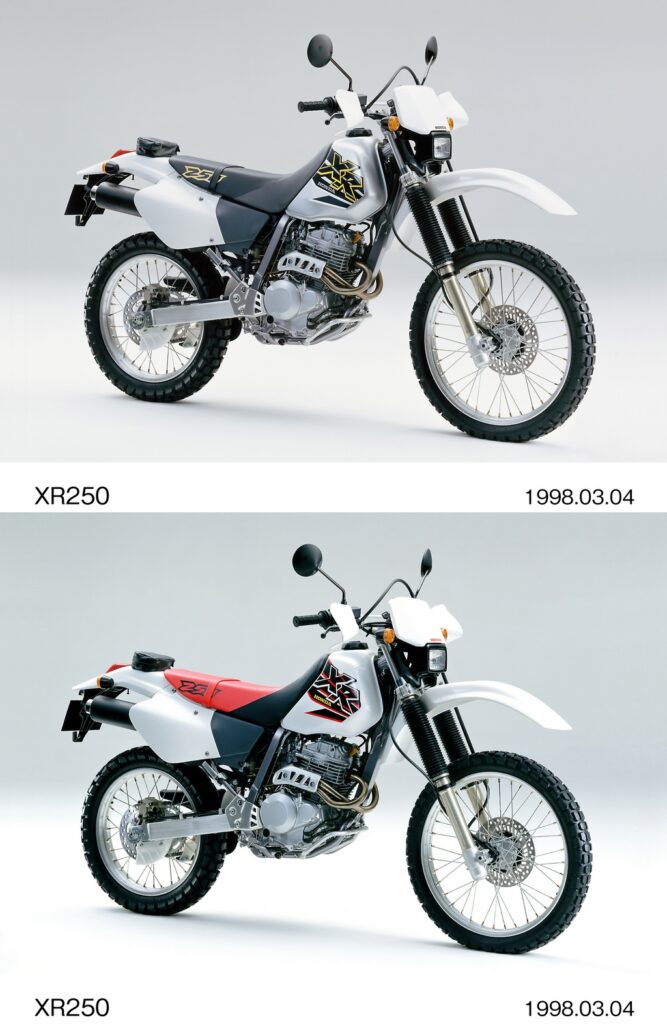
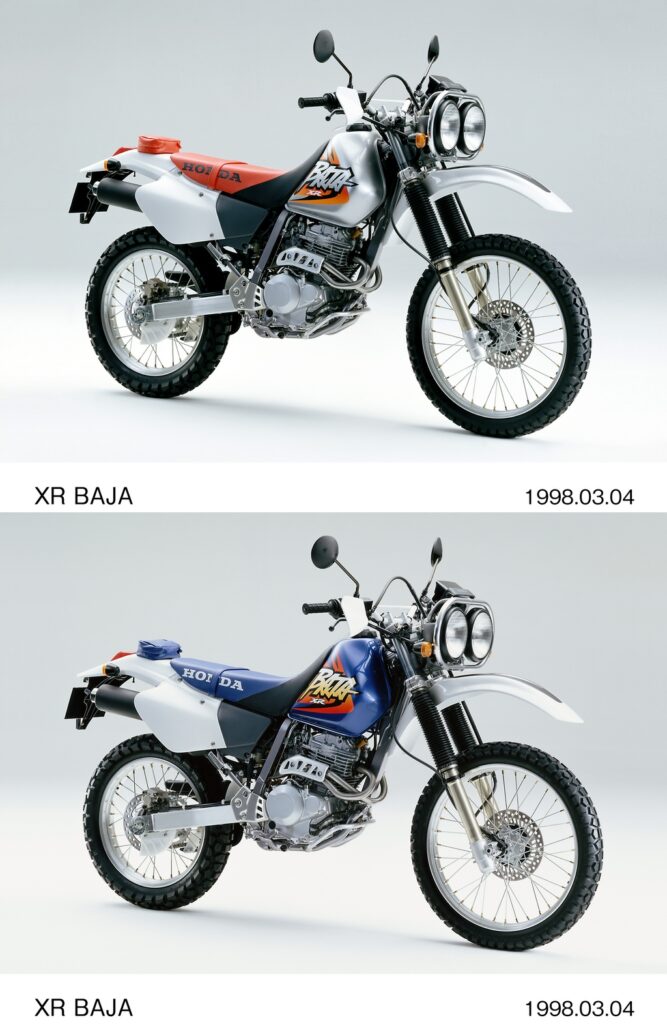
The BAJA released in July 1996 got a larger fuel tank, up from 9.7 L to 14 L, suspension settings that make it easier to reach the ground, and a wider seat. In 1998 the colours changed: Ross White and Boon Silver Metallic for the XR250, and Sahara Blue Metallic and Fresh Silver Metallic for the BAJA (from Honda's press release).
2000: New Colours and Japanese Emissions Compliance
For the 2000 model, the XR250 came in Fighting Red and the XR BAJA in Nimbus Grey Metallic. The slim shape from the fuel tank to the seat was carried over from the earlier models.
In addition, both the XR250 and the BAJA got an exhaust air injection system (a secondary air system) and revised carburettor settings to meet Japan's emissions regulations.
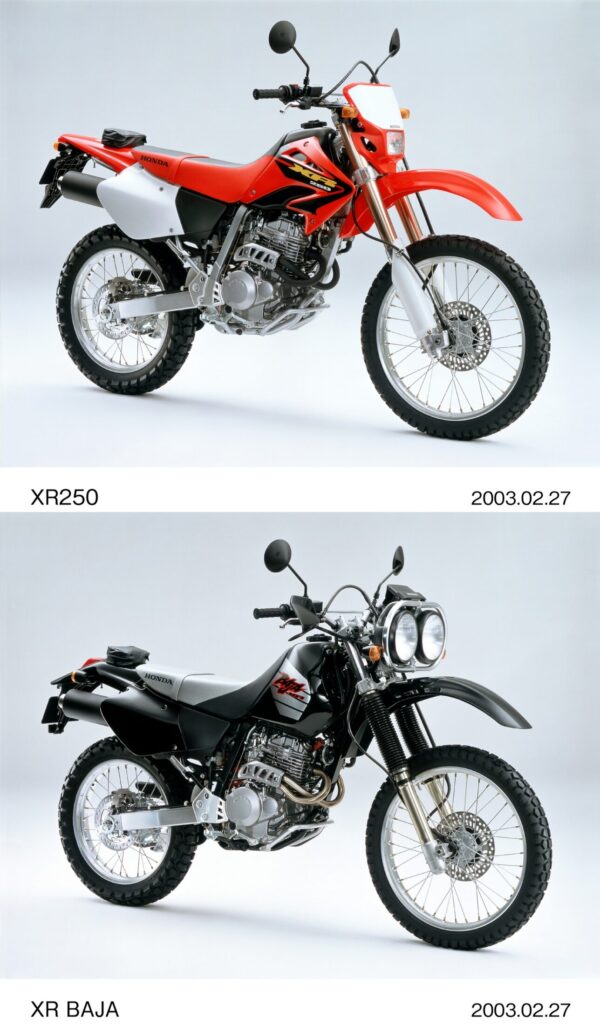
2003: Upside-Down Forks, Shrouds and a Digital CDI for the XR250
2003 brought big changes for the XR250. The biggest was the new 43 mm upside-down front forks. Suspension travel also grew by 5 mm. Shrouds were added on both sides of the fuel tank, which changed the look.
The BAJA, on the other hand, only got new colours that year and kept its conventional forks. From this point on, the XR250 and the BAJA became clearly different bikes.
With this model change, the XR250 also got a digital CDI unit for better control at low and medium engine speeds. The meter changed from a digital display to an analogue type that is easier to read on rough ground (from Honda's press release).
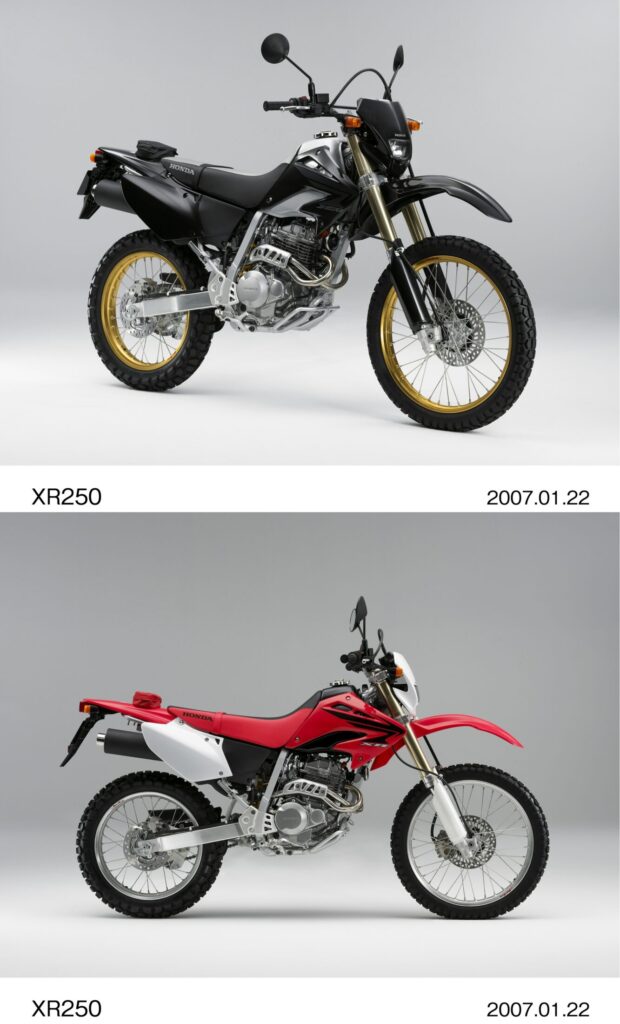
In the December 2004 colour change, Extreme Red was added for the XR250, and the black bike got gold wheel rims. In March 2006 the shroud stripes and some other details were changed. The January 2007 colour change (gold rims on the black bike and a chrome-plated fuel tank cap) was the last model. The last BAJA was the 2003 model, and the BAJA does not appear in Honda's press releases from December 2004 onwards.
3. Conventional or Upside-Down Forks? Choosing by Suspension Type
Conventional Forks on the Early and Middle Models (1995–2002)
The 1995–2002 XR250 and every BAJA model year have conventional (right-way-up) forks. Conventional forks are said to be less rigid than upside-down forks and to feel more supple.
They are also simple in construction and easy to maintain. Because the inner tubes (stanchions) are at the top, they are said to be less likely to be damaged by stones and mud.
From the HONDA SUPER XR / XR BAJA Factbook, "Dimensions / Suspension" page (in Japanese)
How Upside-Down Forks Changed Rigidity and Handling from 2003
The upside-down forks used on the XR250 from 2003 make the front end more rigid. They are said to flex less under hard braking and in corners, which makes it easier to hold your line.
That rigidity helps on rough ground such as rocky trails. Conventional forks offer suppleness, while upside-down forks are better suited to sporty riding.
HONDA XR250 / XR BAJA press information, February 2003 (PDF, in Japanese)
Advantages of Conventional Forks Off-Road
Off-road, the advantage of conventional forks is said to be that they flex a little and follow the ground well. They suit riders who want easy handling at low and medium speeds.
Maintenance and Durability: Which Is Easier to Keep?
If easy upkeep matters most to you, I think conventional forks have the edge. The inner tubes sit at the top, so they are less likely to be damaged by stones and mud, which lowers the risk of oil leaks.
On upside-down forks, the inner tubes are close to the ground, and damage to them easily leads to oil leaks, so clean them regularly. I also think conventional forks are easier to overhaul.
Choosing a Fork Type by How You Ride
For relaxed long-distance touring, or if you want to keep maintenance to a minimum and ride for many years, I think conventional forks suit you.
On the other hand, if you want to ride on a track, ride trails hard, or enjoy sporty riding on tarmac, a model with the more rigid upside-down forks is a better fit.
4. What Makes the XR BAJA Special: Its Own Equipment
The BAJA's Signature: Large Twin Headlights
The signature of the XR BAJA is its large twin headlights. Compared with the single headlight of the XR250, they light a wider area, which is reassuring on mountain roads at night or on trails with no street lights.
Its distinctive looks are also part of the BAJA's charm.
A Fuel Tank Made for Long-Distance Touring
Another feature of the XR BAJA is its 14 L fuel tank (from July 1996; the XR250 has 9.7 L). In mountain areas with few petrol (gas) stations, you worry less about fuel.
A full tank does make the bike heavier, but being able to fill up less often is a big advantage on tour.
My BAJA does about 30 km/L, so on paper a full tank should take it more than 400 km.
Suspension Settings Compared with the Standard XR250
With the 1996 update, the XR BAJA got suspension settings that make it easier to reach the ground. Its seat height is 860 mm, compared with 870 mm for the XR250 (2000 model specifications).
I am 167 cm tall, and on my BAJA I can just touch the ground with the toes of both feet. It makes me a little nervous, but the bike is light, so I can hold it up.
While the XR250 focuses on nimbleness on trails, the BAJA focuses on being easy to handle on tour.
5. Buying a Used Bike: What to Check Beyond the Year and Mileage
Fuel System (Carburettor) Condition and Starting
When choosing a used XR250, the condition of the carburettor matters too. First, check how it starts from cold. See whether it starts smoothly and idles steadily. If the revs are slow to drop once it is warm, or it stalls easily, suspect a blocked carburettor, or an air leak (secondary air) caused by perished rubber parts.
The carburettor easily goes out of tune if the bike sits unused for a long time. If it runs well, there is a good chance the previous owner rode it regularly.
Oil Care for the RFVC Engine and Notes on the Dry-Sump System
The XR250's RFVC engine is air-cooled, so oil care is important. The XR250 uses a dry-sump system, with part of the frame serving as the oil tank. Follow the owner's manual or the service manual for how to check the oil level.
When choosing a used bike, check for signs of leaks around the oil filler on the frame, and whether the drain bolt is damaged. After starting the engine, also listen for a loud knocking noise from the top of the engine.
Suspension Oil Leaks and Rust on the Inner Tubes
The condition of the suspension affects not only how the bike rides but also how much you will spend on maintenance after buying. Pay particular attention to pitting rust on the front fork inner tubes. Rust damages the oil seals every time the forks move, which leads to oil leaks. Re-plating or replacing parts is expensive, so check the bike in person for rust.
Also check for seepage hidden under the fork boots and rust on the rear shock rod.
Rust Inside the Fuel Tank from Age
On an XR250 or BAJA built nearly 20 years ago or more, rust inside the fuel tank is another thing to check. A bike that has been left unused for a long time may have rust inside the tank. If rust gets into the fuel line, it can block the carburettor jets and cause stalling or starting problems.
When you look at the bike, shine a torch (flashlight) through the filler opening and look for brown rust. If there is rust, it needs to be removed with a dedicated chemical, and in bad cases the tank has to be replaced.
Check the Frame and Bodywork for Damage Before You Buy
Many XR250s and BAJAs have been ridden off-road, so check that the frame has not been bent in a crash. First, look at the bike from the front and from behind, and check the handlebar position, the line of the front and rear wheels, and the angle of the rear mudguard (fender) for anything that looks wrong.
If you see flaking paint or unnatural creases around the steering head or near the engine mounts, the bike may have taken a heavy impact. Frame repairs are not easy, so check this before you look at how clean the bodywork is.
6. Parts Supply and Customising
Getting Genuine Honda Parts
It has been nearly 20 years since the last XR250, so some genuine parts are getting hard to find.
Before buying, it is a good idea to ask the dealer whether the parts you are likely to need can still be obtained. Using aftermarket or used parts is another option.
Popular Aftermarket Parts and Common Customisations
Popular aftermarket parts for the XR250 include aftermarket exhausts. For more power, swapping to an FCR carburettor is also popular.
For the controls, hand guards and levers from brands such as ZETA are popular, and for touring, a rear rack is a standard addition. If you choose a bike that already has the parts you want, you can save on buying them later.
Parts Compatibility Between Conventional-Fork and Upside-Down-Fork Models
The XR250 with conventional forks (up to 2002) and the XR250 with upside-down forks (2003 onwards) use different fork diameters (41 mm and 43 mm), so not only the forks but also the triple clamps and other front-end parts are different.
When you use parts from a different model year, check the part numbers in the parts list before you order.
Regular Maintenance for a Long Life
If you want to ride an XR250 for a long time, regular preventive maintenance is important. Oil changes and tappet (valve clearance) adjustment in particular directly affect how well the engine runs.
Something that is easy to overlook is stripping, cleaning and greasing the rear suspension linkage.
At the same time, checking rubber parts such as the insulators and cam chain stretch helps prevent major failures. Leave anything you find difficult to a workshop.
A Basic DIY Maintenance Guide for the XR250 / BAJA
The XR250 is a simple air-cooled single, so it suits people who want to start doing their own maintenance. Start with an oil change. Because it is a dry-sump engine, some steps, such as checking the oil level, are different from other bikes, but it is a good chance to understand how the bike works.
Also try cleaning the air filter, lubricating the chain, and checking the spark plug yourself. It will help you understand your bike better. Working on it yourself with the service manual open is one of the pleasures of owning an XR.
7. Conclusion: Recommended Model Years by Use
From Town Riding to Sporty Riding: The 2003-On Upside-Down-Fork Models
The XR250 with upside-down forks from 2003 onwards has a more rigid front end and sharper handling.
The bodywork with shrouds and the easier low- and mid-range control from the digital CDI are also attractive. Because these bikes are newer, I think it is also easier to find one in good condition.
For Easy Maintenance: The 1995–2002 Conventional-Fork Models
If you value easy maintenance and a supple ride, the conventional-fork models (1995–2002 for the XR250) are worth considering. Models from 2000 onwards have the air injection system and meet Japan's emissions regulations.
Conventional forks are simple in construction, and the advantage is that they are easy to maintain.
For Lots of Night Riding: The XR BAJA
If you often ride at night or go on camping trips, I recommend the XR BAJA.Its large twin headlights are reassuring on dark roads, and the 14 L tank (from July 1996) means fewer fuel stops.
From 1996 onwards it also has a wider seat. If you want a bike for travelling, I think the BAJA makes a good partner.
For the Pride of Ownership: The 2007 Final Model
The 2007 model is the last of the MD30 XR250s. The black bike has gold wheel rims and a chrome-plated fuel tank cap.
Bikes in good condition are getting rare, but if you want to own the very last model, it is worth considering.
Summary: Buy Smart by Balancing Budget and Condition
With an XR250 or BAJA, do not judge by model year or mileage alone. The smart way to buy is to look at the total cost: the purchase price plus the cost of initial maintenance. A cheap early model is tempting, but quite often a suspension overhaul or fuel system cleaning due to age ends up costing more than a later model would have. On the other hand, if you insist on a final model at a premium price, you may not have enough left for the maintenance that really matters.
Look for a bike that has had good oil care and has been stored well (this matters more than mileage), and that comes with maintenance records. Scratches on the bodywork can be fixed later, but check the condition of the engine and whether the frame is bent first. Then I think it is best to use the rest of your budget to renew the oils, grease and rubber parts.
Notes for readers outside Japan
"Emissions regulations" in this article means Japan's regulations.
Advice about parts supply and dealers is based on the situation in Japan. Check with a dealer or parts supplier in your own country.
The Honda links in this article go to Japanese-language pages.
More XR250 / XR BAJA (MD30) articles from my garage: