Hello everyone. Today's post is about which way round to fit an oil seal.
When I replaced the swingarm bearings on my G650GS, I wasn't sure which way round to fit the new oil seals. Searching online, you often see the rule "the side with the markings faces out", but with the seals I used, that rule alone could not decide the direction.
So I looked up the seal makers' documents, and here is what I found.
Conclusion: the lip decides which way an oil seal goes
- The basic rule: face the lip (the side where you can see the spring) towards the oil or grease. The back face goes outside (the air side)
- Markings are usually on the back face, so "markings face out" is often right. But there are exceptions
- For the double-lip IKO DS type, face the main lip inwards to stop grease leaking out, or outwards to keep mud and water out
- If in doubt, check your bike's service manual or the seal maker's documents
Oil seal basics: what they do and which way they face
What an oil seal does
Oil seals are used in many places on a motorcycle: the front fork, wheels, engine, swingarm and so on.
They have two jobs: to stop engine oil, fork oil, grease and so on from leaking out, and to stop water, dust and mud from getting in.
The part that keeps the oil in is the tip, called the seal lip. The lip is designed to be pressed against the shaft by the pressure on the inside, so the direction of the lip is the direction of the seal.
The basic direction: lip towards the side being sealed
The Japanese seal maker Sakura Seal explains that a seal should be fitted "with the seal lip on the side of the medium being sealed (so that the back face is on the air side)". (Sakura Seal: how to fit oil seals (in Japanese))
So for a normal single-lip oil seal, face the lip (the side where you can see the spring) inwards, towards the oil or grease, and the flat back face outwards.
"Markings face out" is a rule of thumb, with exceptions
On most ordinary oil seals, the maker's name and size are marked on the back face, so "markings face out" is often right.
But some seals have no markings, and some have lips on both sides. There are also seals that you deliberately fit the other way round, depending on the purpose (such as the DS type I describe below).Don't decide by the markings alone; look at which way the lip faces to be sure.
Which way do front fork oil seals go?
A front fork oil seal's job is to keep the fork oil inside. The basic rule is to fit it with the lip (the side where you can see the spring) facing the fork oil, that is, downwards (into the outer tube). A dust seal, which keeps mud and dust out, goes on top of it.
Fork designs differ from bike to bike, so always check your bike's service manual in the end.
When fitting an oil seal, put rubber grease on the lip and push it in straight with a proper seal driver, so you are less likely to damage the lip. I show how I did it when assembling the front forks on my XR250 BAJA in the article below (in Japanese).
These are the tools I used then: a STRAIGHT front fork oil seal driver and SUPER ZOIL rubber grease.
Real example: the double-lip IKO DS seal faces different ways depending on the purpose
The seals I used for the G650GS swingarm bearings
The seal that made me unsure was the IKO (Nippon Thompson) oil seal DS22284, which I used when replacing the swingarm bearings on my G650GS. As the numbers in the part number suggest, it is 22 mm inside diameter, 28 mm outside diameter and 4 mm wide.
I describe the bearing replacement in the article below (this is the seal I fitted in "3. Press in the oil seals").
I levered the old seals out with a large flat-blade through-tang screwdriver (made by STRAIGHT). To avoid scratching the inside of the bore the seal sits in, I hooked the tip of the screwdriver on the edge of the seal and eased it up a little at a time.
It is not the one I used, but a similar through-tang screwdriver is the STRAIGHT 6.0 × 100 mm flat-blade (for reference).
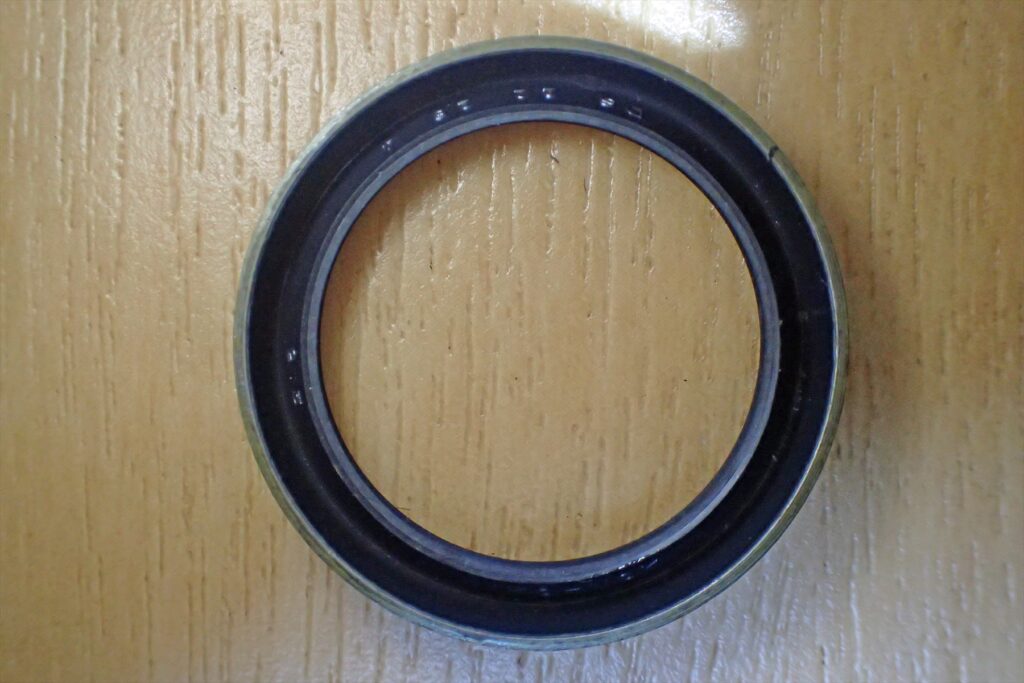
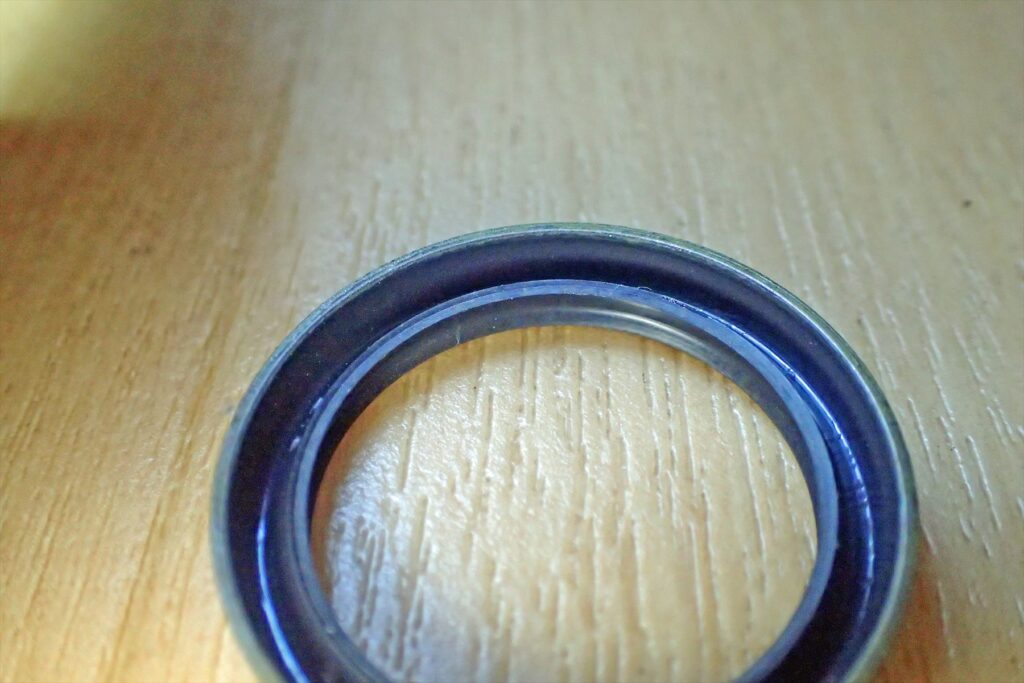
This is the seal. This is the side with the markings.
The marked side seen from an angle looks like this.
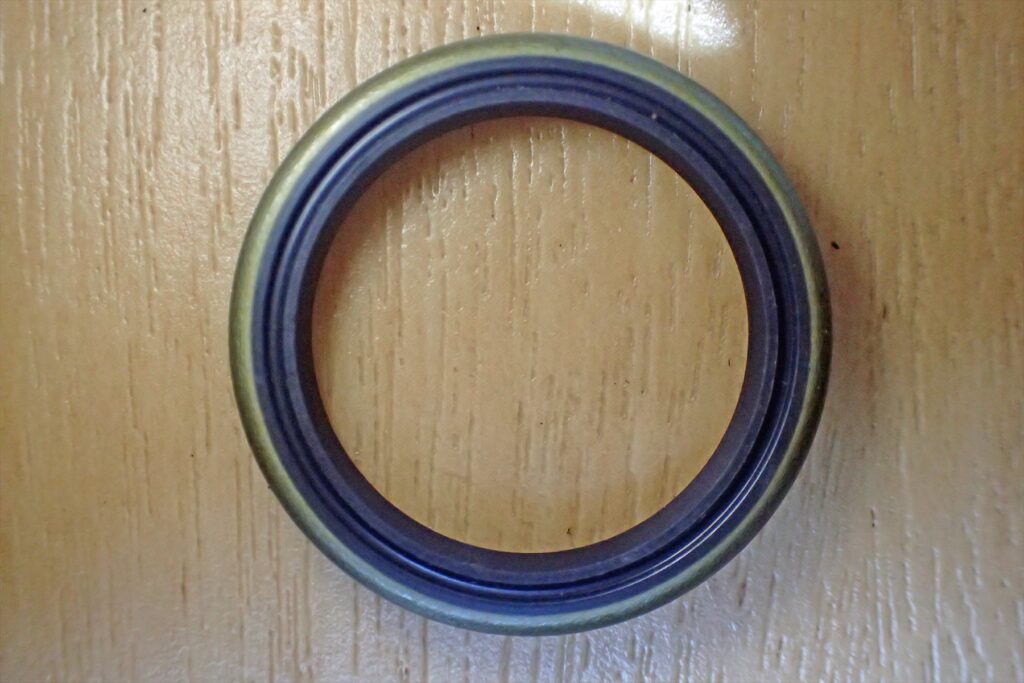
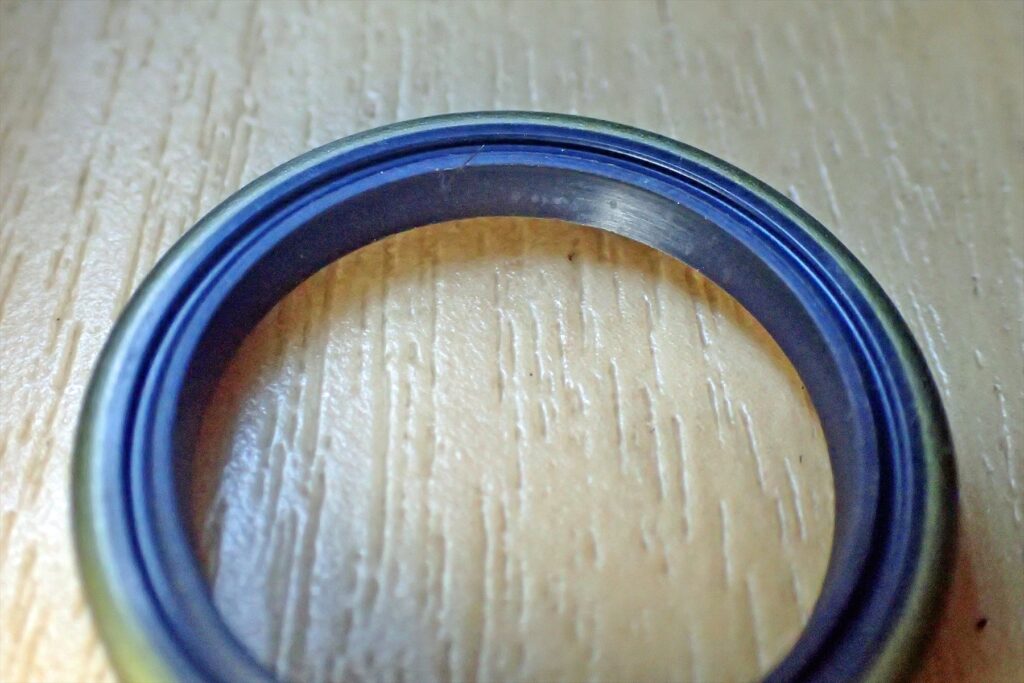
This is the side without markings.
The unmarked side seen from an angle looks like this. It looks as if there are two lips side by side. Somehow I felt like facing this side outwards, and that is what made me look it up.
The maker's explanation and catalogue
Looking it up on Nippon Thompson's (IKO's) website, I found that this seal is a "seal for needle roller bearings". In short, the website says:
These are thin seals made of a sheet metal ring and synthetic rubber. They are made to the same sectional height as IKO needle roller bearings, so you can fit them right next to the bearing to keep grease in and dirt out. (If you use them with needle roller bearings that have an inner ring, you need a wide inner ring.)
IKO: Seals for Needle Roller Bearings (English)
The product catalogue also explains which way to fit each type.
Source: Nippon Thompson Co., Ltd. product catalogue, "Seals for Needle Roller Bearings" (PDF, in Japanese)
To summarise:
- Single-lip OS: to stop grease leaking out, face the lip inwards; to keep dirt out, face the lip outwards
- Double-lip DS: to stop grease leaking out, face the main lip inwards; to keep dirt out, face the main lip outwards
My seal is a DS, so it has two lips. With the DS type, which side faces out depends on what you want to prioritise. You can't simply say "the marked side faces out".
I fitted the main lip facing outwards
The swingarm pivot gets a lot of mud and water when you ride. So I made keeping dirt out my main aim, and pressed the seals in with the main lip facing outwards.
On the other hand, where keeping the grease in matters more, face the main lip inwards. Decide which you want to prioritise first, then choose the direction.
For greasing the bearings, I use a water-resistant extreme-pressure grease (Omega 77).
It's a great help that makers now publish this kind of information online.
What happens if you fit it the wrong way round?
If the lip does not face the oil or grease, the oil inside leaks out more easily. On a front fork, this causes oil leaks.
If the lip meant to keep dirt out faces the wrong way, rainwater and mud get in more easily, which causes rust and wear in the bearings.
When you replace a seal, take a photo of which way the old seal faces before you remove it, and you can't go wrong.
Summary
- Decide the direction of an oil seal by the direction of the lip, not the markings
- The basic rule is lip towards the oil or grease. "Markings face out" is only a rule of thumb
- On a front fork, the lip faces the fork oil (downwards)
- With the double-lip IKO DS type, the direction of the main lip depends on the purpose. On my swingarm, I faced the main lip outwards to keep dirt out
Related articles:
- Rear linkage maintenance: bearing replacement (in Japanese)
- Thoughts on bearings: needle bearings in the rear linkage and swingarm (in Japanese)
- Fork oil viscosity chart: compare brands by viscosity at 40°C
*Written by the author (18 years of doing my own maintenance, not a qualified mechanic) based on work on my own G650GS and the makers' published documents. Always follow your bike's service manual and the maker's instructions for the direction of parts and how to do the work.