Hi everyone, Boo here.
Today's topic is the difference between two versions of the Honda XR250: the MD30 (the Japan-market road bike, sold as the XR250 / XR250 BAJA) and the ME08 (the competition-only model, the XR250R).
I have already written about the differences between the MD30 and ME08 front forks. This time, I look inside the engine, at the crankshaft bearings in particular.
(This post simply shows that the crankshaft bearings differ in these ways. It is just a quick comparison, not a repair guide.)
If you own an XR250R (ME08), this is what your crankshaft bearing looks like next to the one in the road-going MD30.
By the way, here is the link to my series on the front fork differences.
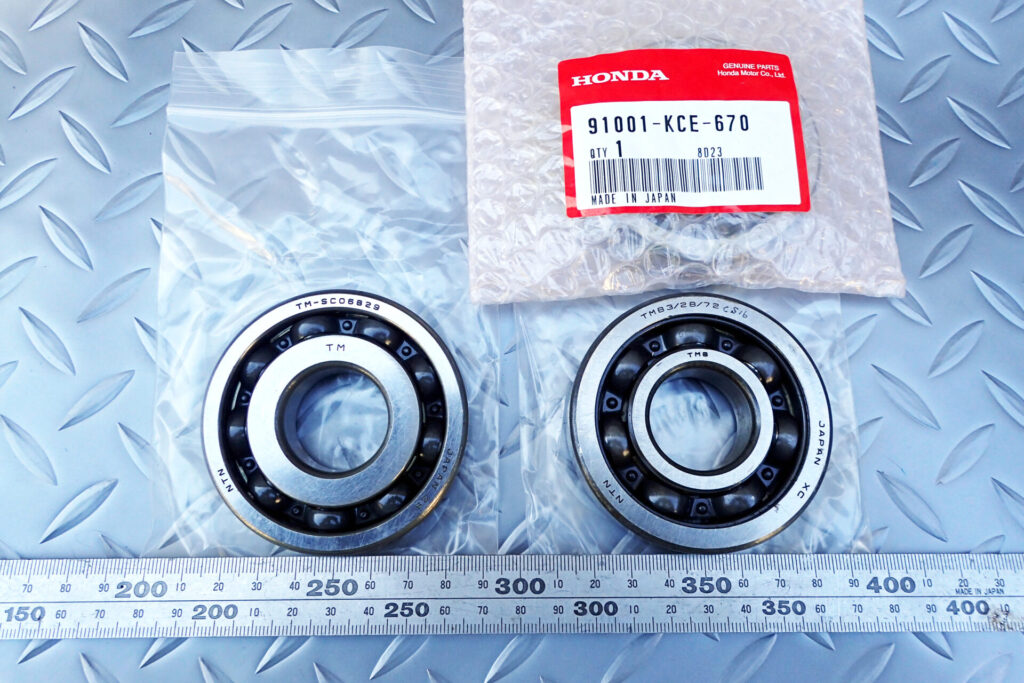
The photo above shows the two crankshaft bearings.
The one on the left is from the MD30, and the one on the right is from the ME08.
They are the same size (28 mm bore, 72 mm outside diameter), and both are made in Japan by NTN. But you can see that the inner and outer rings are different thicknesses, and that the balls (rolling elements) are a different size and number.
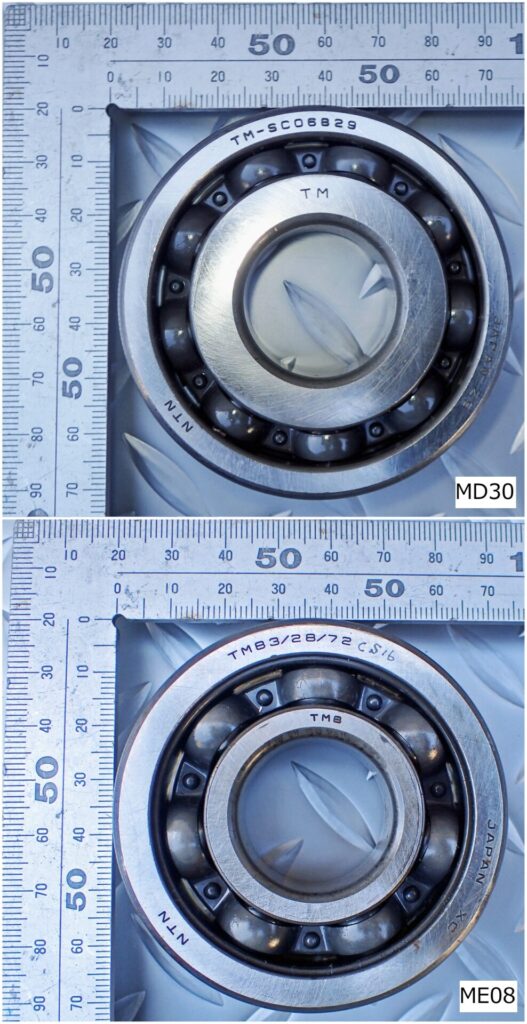
Here is a closer look at each bearing.
I summarised the differences that I, as an amateur, could spot from these photos in the table below.
There are more differences than you might expect.
| MD30 | ME08 | |
| Honda part number | 91001-KBR-003 | 91001-KCE-670 |
| Bearing maker (marking) | NTN, Japan | NTN, Japan |
| Size (bore × outside diameter) | 28 mm × 72 mm | 28 mm × 72 mm |
| Outer ring thickness (relative) | Thinner | Thicker |
| Outer ring marking | TM-SC06829 | TM83/28/72CS16 (CS16 looks handwritten) |
| Inner ring thickness (relative) | Thicker | Thinner |
| Inner ring marking | TM | TM8 (or TMB?) |
| Ball diameter (relative) | Smaller | Larger |
| Number of balls | 9 | 7 |
Some of the markings on the ME08 bearing look handwritten, so I wonder if it is a special-order part.
I think the engine is used differently on a road bike and on a competition bike.
My impression is that a competition engine is kept revving all the time, and the engine speed changes sharply and often.
That is probably why the crankshaft bearings are different, too.
Why Are They Different? My Thoughts on Ball Size, Ball Count and Ring Thickness (Speculation)
How much load a ball bearing can carry (its basic dynamic load rating) is set by a calculation in the standards (ISO 281 / JIS B 1518). In that formula, the load capacity is roughly proportional to the number of balls to the power of 2/3, multiplied by the ball diameter to the power of 1.8. In other words, ball size matters much more than the number of balls.
Here is what that gives for the MD30 (9 balls) and the ME08 (7 balls).
| ME08 ball diameter (relative to MD30) | Load capacity (MD30 = 1) |
| 1.1 × | 1.00 (the same) |
| 1.2 × | 1.17 |
| 1.3 × | 1.36 |
From the photos, the ME08 balls are clearly larger. So even with two fewer balls, I think the ME08 bearing is designed to carry a higher load.
From here on, I have no information from the manufacturer. This is my own speculation.
- Seven larger balls (ME08): I think the bearing was made stronger against heavy loads and shocks to suit competition use, such as landing jumps and sharp changes in engine speed.
- Thicker outer ring (ME08): The bearing is pressed into an aluminium crankcase. Aluminium expands more with heat than steel, so the fit loosens as the engine gets hot. A thicker outer ring deforms less and is less likely to creep (turn inside the case). I think that was the aim.
- Thinner inner ring (ME08): The inner ring is supported by the steel crankshaft, so I think making it thinner causes few problems. Since the bore and outside diameter are the same, this is probably where the space for the larger balls came from.
- Better for high revs or not? Larger balls are a disadvantage in terms of centrifugal force. On the other hand, the circle the balls run on moves inwards, so the balls travel more slowly, which is an advantage. Which effect wins cannot be decided without measuring the dimensions, so I will leave that question open for now.
For reference, the engine parts that differ between the MD30 and the ME08 include the crankshaft, balancer, piston, piston pin, camshaft, cam sprocket, cam chain and starting method (and perhaps the gear ratios as well?).