When a helmet lock is defeated, it is usually the fabric chin strap that gets cut. If you only hook the chin strap's D-ring over the helmet holder or a cable, the helmet is gone the moment someone cuts the strap with a blade.
The basic way to stop your helmet being stolen on a ride is to pass a cable lock through the chin bar (not the chin strap) and lock it to a part of the bike that can't be removed, such as the handlebars or grab rail.
In this post I show, with photos, how I actually lock my helmet with the cut-resistant cable lock I bought (RAINCORE, 60 cm). Then I cover carrying your helmet with you, and hiding it in a top box or seat bag.
Three ways to protect your helmet: lock it, carry it, hide it
There are three main ways to protect your helmet from theft on a ride. Combine them to suit the situation.
| Method | What you use | Pros | Cons |
|---|---|---|---|
| Lock it | Cable lock | Small and light, so you can always carry one. Ready to use as soon as you get off the bike | Not completely cut-proof. The length you need depends on the bike |
| Carry it | Helmet bag, backpack with a helmet holder | It isn't left on the bike, so it can't be stolen from the bike | Something extra to carry while sightseeing or eating |
| Hide it | Top box, large seat bag | Out of sight. Also protected from rain and direct sun | Needs enough space for the helmet. Fabric seat bags are easy to cut |
Below, I explain each one, starting with locking, which I have actually tried.
Leaving your helmet on the bike? Effective helmet locks and anti-theft gear
The chin strap D-ring can be cut! Why you should lock through the chin bar
When you lock a helmet, hooking only the chin strap D-ring (the metal rings) over the holder is a weak method.
The chin strap is fabric, so it can be cut with scissors or a knife. Once it is cut, the helmet can be taken away undamaged. So with a full-face helmet, the basic method is to pass the cable through the chin bar and lock it.
I think the reason people say "helmet locks are pointless" is mainly this weakness of locking only the chin strap. The lock itself isn't pointless; how secure it is depends on what you put it through.
Even if it's a bit of a bother, the first step in protecting your helmet is not to leave it in a state where a thief thinks "I can just cut it and take it".
Points to watch when locking an open-face (jet) helmet
An open-face helmet has no chin bar, so you can't lock it the same way as a full-face.
Because the face opening goes all the way to the bottom edge, a cable passed from the face opening to the neck opening simply slips out.
As far as possible, find a way to pass the cable through metal parts or other strong parts.
Is the standard helmet lock enough? Why you should add a cable lock
Many bikes have a helmet holder as standard, but for better security I recommend also using an aftermarket cable lock.
On some bikes the standard holder is in an awkward place. If you force the helmet on, it can hit the bike and get scratched, or the inside can get wet in the rain. And it is the chin strap D-ring that goes on the holder, so, as above, the helmet can be removed by cutting the strap.
This is where a combination or key cable lock helps. If you pass it through the chin bar and lock it to something solid like the handlebars or frame, it takes longer to cut, and it shows at a glance that you have taken precautions. Carrying a pocket-sized cable lock means you can leave the bike with peace of mind on a ride.
However, a cable lock doesn't completely prevent theft. Its job is to make stealing take more time and effort, so your helmet is less likely to be targeted.
Trying the cut-resistant RAINCORE cable lock
This is the cable lock I bought. I was looking for one that would be hard to cut, for the reasons above, and found the RAINCORE security cable. The sales page says it is a "Korean patented product", so it appears to be made in Korea. It is actually sold as a bicycle lock.
According to the sales page, the cable has five layers, from the outside: synthetic fibre, glass fibre, composite fibre, composite fibre and an alloy steel core. With different materials layered together, it looks hard to cut with any single cutting method.
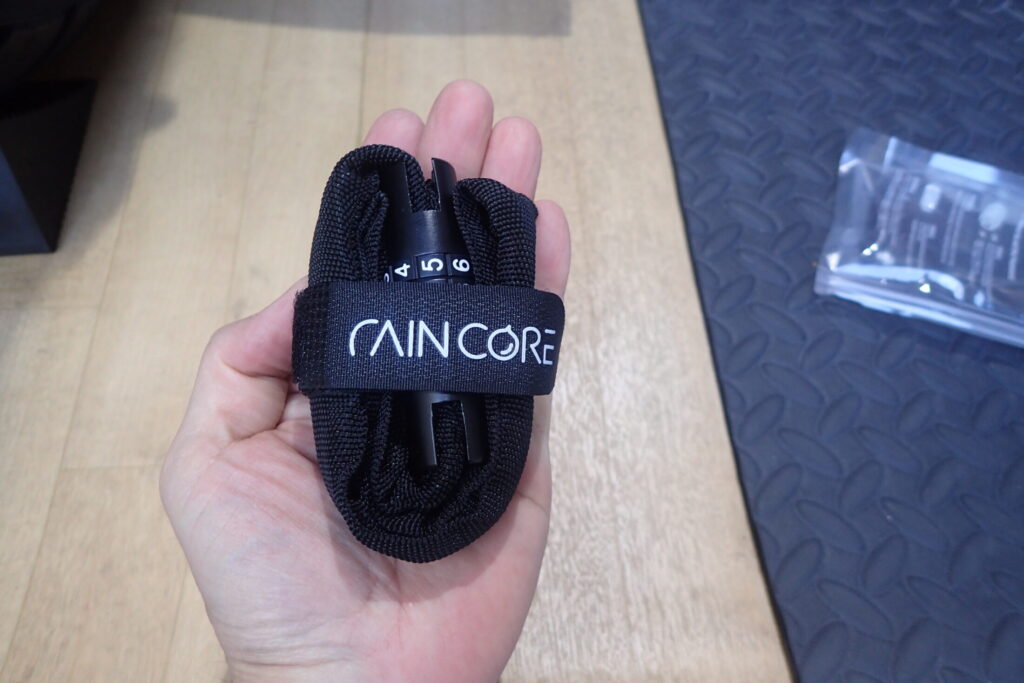
Folded up, it fits in the palm of your hand and is easy to carry. This one is 60 cm long.
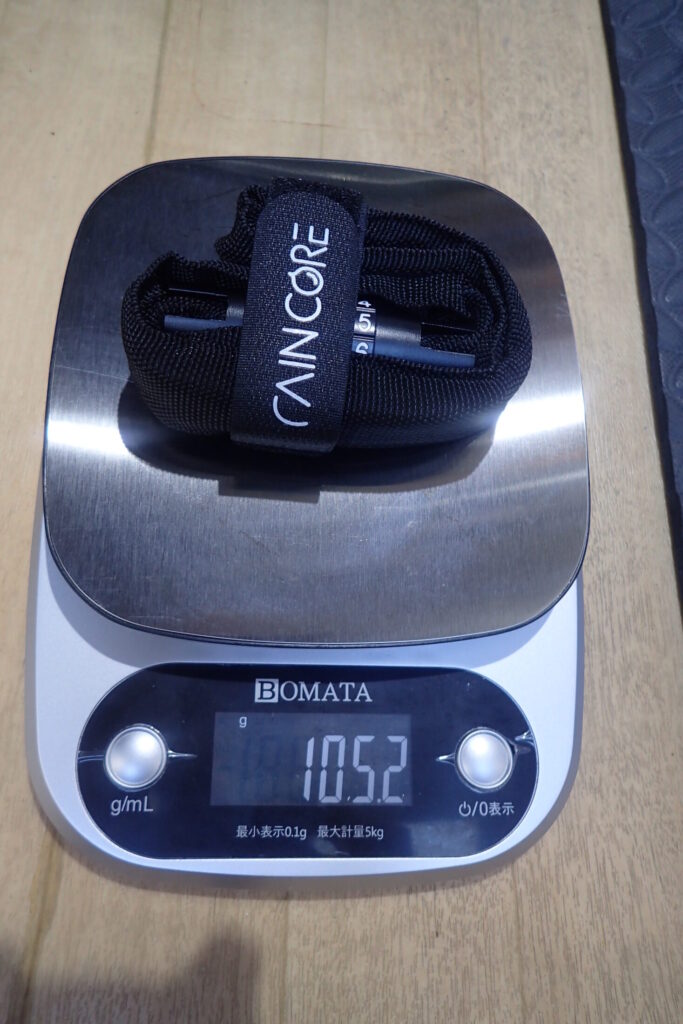
It weighs about 100 g (my measurement), so it is light.
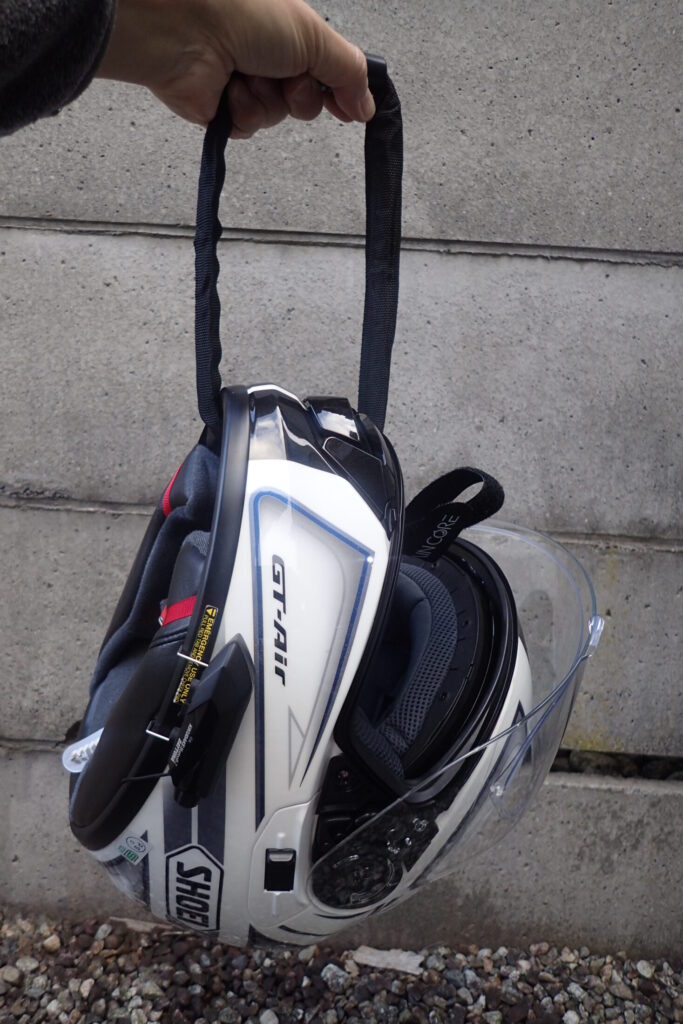
Through the chin bar, there is about this much slack, as in the photo above.
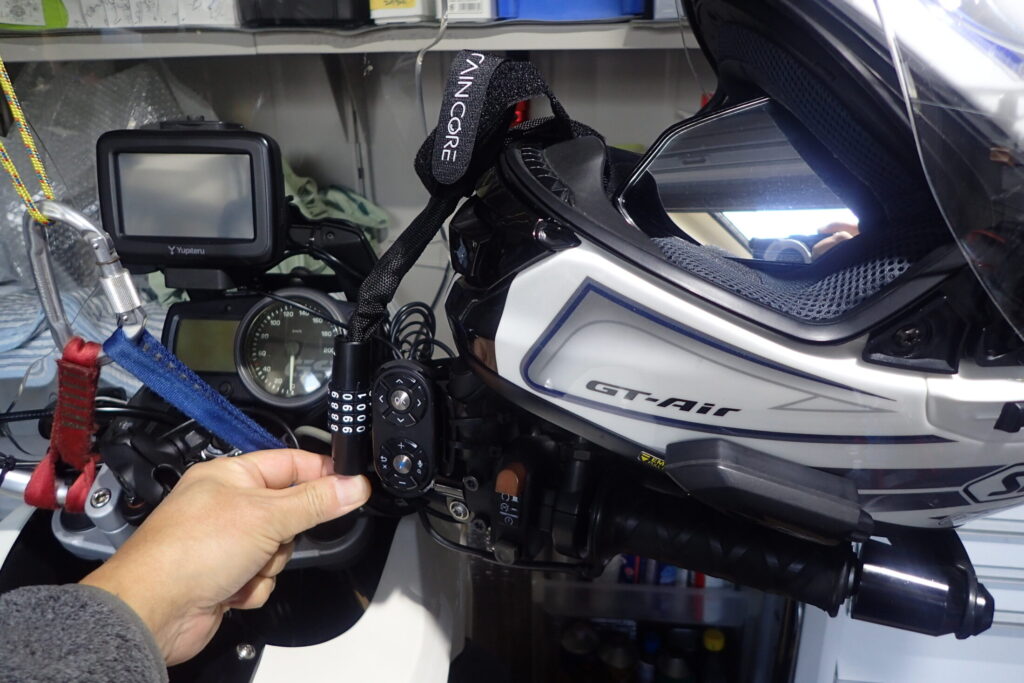
When I leave my helmet on a ride, I most often hang it on the mirror. With it hung on the mirror, passing the cable through the chin bar and round the handlebar, 60 cm was just long enough. On some bikes, 60 cm may not be long enough.
The bike in the photo is a BMW G650GS.
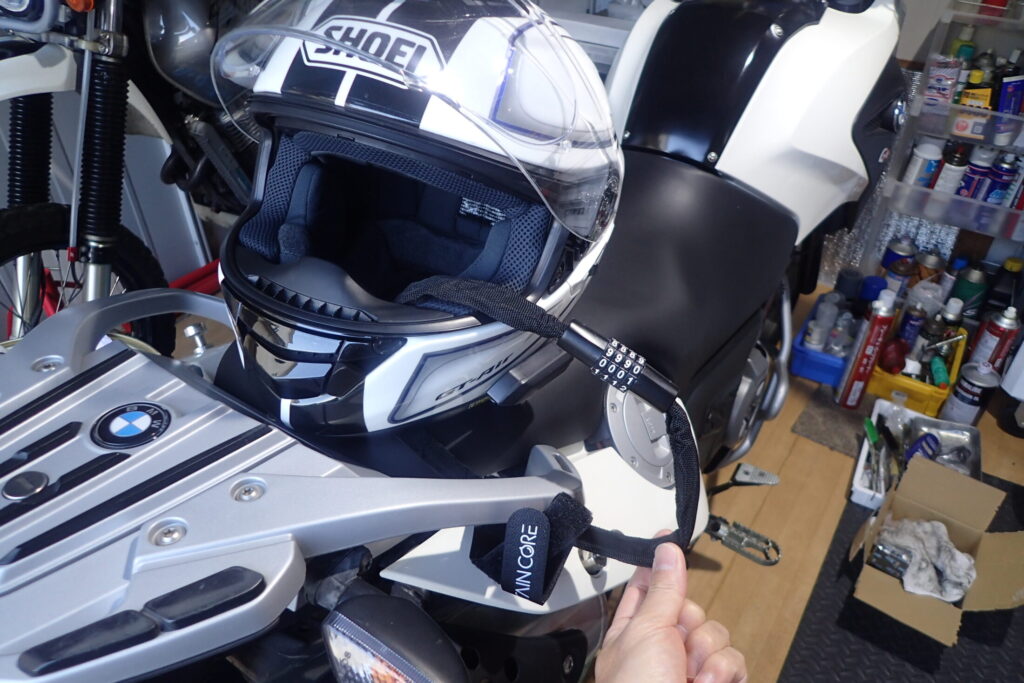
With the helmet on the seat and the cable joining the chin bar to the grab rail, there was plenty of length to spare. This may be the best way to leave it. But you can't put the helmet there if you have a seat bag on, and a strong wind could blow the helmet off onto the bike.
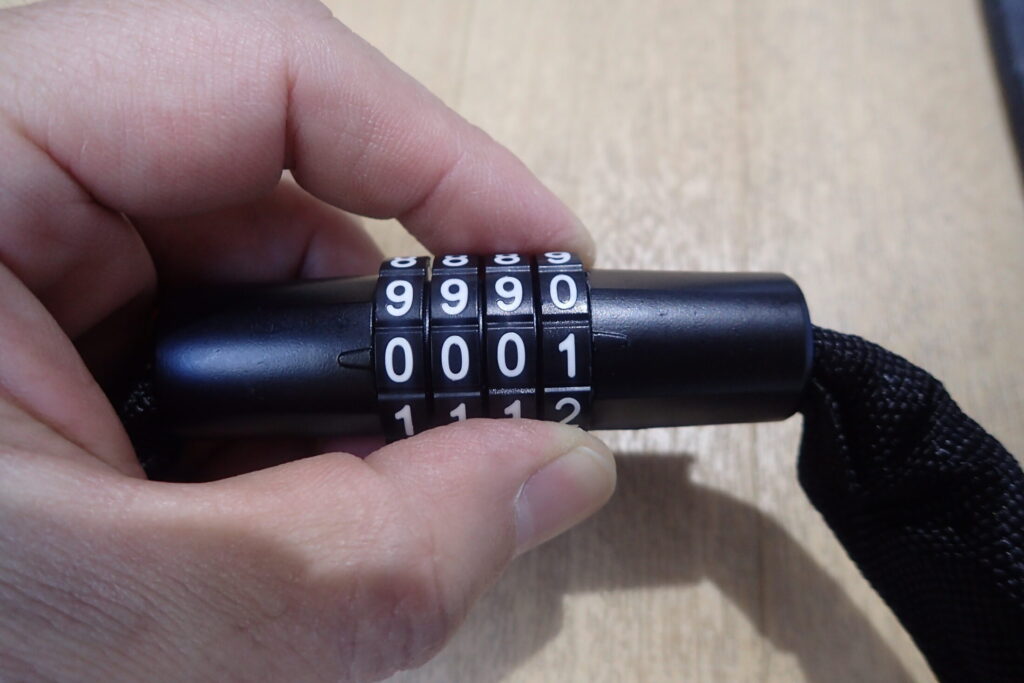
Lastly, this security cable has a combination lock, and the dials turn with a solid click, which feels good quality. It isn't cheap, but it isn't expensive either, and I think it's good value for the peace of mind it gives on a ride.
Longer versions than 60 cm are also available. If the place you lock to is far from the helmet on your bike, consider a longer one.
Don't leave it on the bike! Handy items and ways to carry your helmet
Comfortable sightseeing: a helmet bag that leaves both hands free
The surest way to prevent theft is not to leave the helmet on the bike, but to carry it with you.
But carrying a helmet in your hand while sightseeing or eating is a nuisance. That's where a compact folding helmet tote bag or a helmet bag with a shoulder strap is handy. You can hang it from your shoulder, leaving both hands free for shopping and taking photos.
In a bag, you also worry less about bumping it into people or getting it dirty on a restaurant seat.
For backpack users: a backpack with a helmet holder
If you usually ride with a backpack, you can choose a backpack with a helmet holder. It has a net or flap on the front to hold the helmet, so you can attach it when you get off the bike and walk off.
You can carry the helmet without squashing what's inside the bag, so it copes even when you pick up souvenirs. It suits times when you'll be away from the bike for a long time, or when you park where you can't see the bike.
Hiding it is effective too: using a top box or seat bag
Keeps out rain and thieves: storing it in a top box
The method that is both secure and convenient is storing it in a lockable top box. Locked in a hard case, the helmet can't be seen from outside, so it is less likely to be targeted.
It stays dry in a sudden shower, and the lining is protected from summer sun and heat. Before you buy one, check the maker's product information to see whether your helmet will fit.
I use a GIVI E470N SIMPLY III in unpainted black (now discontinued), which holds one full-face helmet with room to spare.
Using a large seat bag, combined with a cable lock
Even on a bike where you don't want a top box, a large seat bag lets you hide the helmet. With a big seat bag like those used for camping trips, you may be able to fit the helmet in by arranging your luggage.
Even if it doesn't fit in the bag, you can put a rain cover over everything so the helmet can't be seen. But seat bags are fabric and easy to cut, so whether the helmet is inside the bag or strapped on top, also lock it to the bike with a cable lock. Combining hiding and locking improves security.
The risk of helmet theft on a ride, and what happens if it's stolen
Why are helmets stolen? When are they most at risk?
A helmet is easy to take off the bike and carry away. Just hung on the mirror or left on the seat, it can be taken during a few minutes' toilet break or a quick stop at a convenience store.
This isn't only true of expensive full-face helmets; open-face helmets are the same.Thinking "it won't happen to me" is the biggest weakness. Even if you are only away for a short time, take precautions.
If your helmet is stolen, you can't ride home: towing costs and penalty points
The biggest problem if your helmet is stolen is that you can't ride the bike home from there.
In Japan, motorcycle riders must wear a helmet (Road Traffic Act, Article 71-4). Riding without one is a helmet violation and earns 1 penalty point. There is no fine, but it is still an offence, and above all you would be riding with nothing to protect your head. Most other countries also require helmets by law.
As a result, you have to deal with it somehow: get a family member to bring another helmet, have roadside assistance carry the bike, or take a taxi to the nearest motorcycle shop and buy a new helmet.Because you didn't have a cable lock costing a few thousand yen, you end up with unexpected costs and a ruined ride.
Summary
- When a helmet lock is defeated, it is usually the chin strap that is cut. Pass the cable through the chin bar, not the chin strap, and lock it to a part of the bike that can't be removed.
- Open-face helmets have no chin bar, so you need to think about where to pass the cable.
- If you'll be away from the bike for a long time, carry the helmet; if you have space, hide it in a top box or seat bag. Hiding and locking work well together.
Ride safe and enjoy your bike!