Hello everyone.
Today I'm showing how I fitted a side stand plate to my G650GS.
Benefits of fitting a side stand plate
A side stand plate has several benefits:
- It enlarges the side stand's footprint, so you can park on surfaces other than asphalt or concrete
- A thick plate makes the bike lean less when it is on the side stand
Benefit 1 helps when parking on a beach (such as the Chirihama Nagisa Driveway in Ishikawa, Japan, where you can ride on the sand).
But I don't think you should rely on it too much on soft ground such as sand.
As for benefit 2, some bikes, especially imported ones, lean over a long way on the side stand, enough to make you worry they might fall over.
Why do some imported bikes lean so far on the side stand?
I think it is related to whether the country where the bike was designed drives on the left or the right.
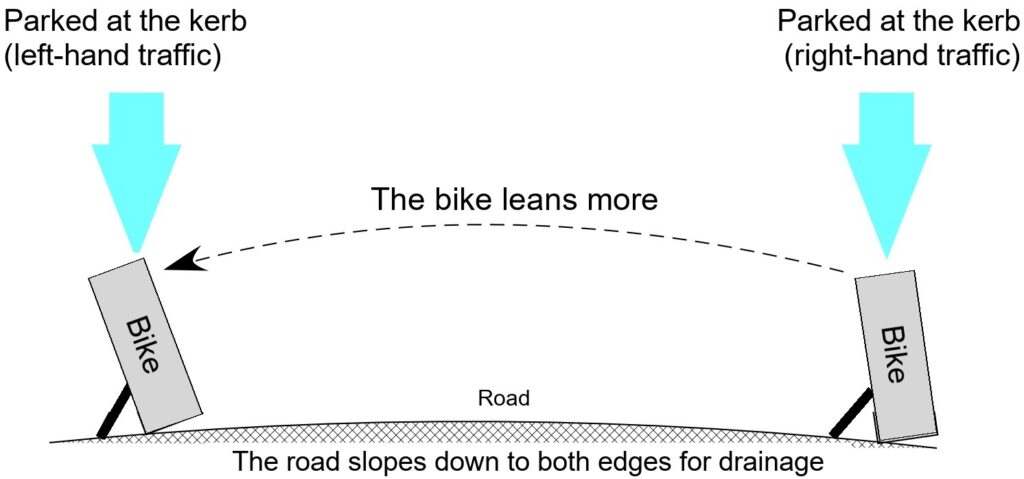
I'll explain with the diagram below.
First, roads are higher in the middle and slope down to both edges so that water drains off.
Now think about parking at the kerb in a country that drives on the right.
There, the side stand touches the road at a higher point than the tyres.
So the side stand can be short.
If you ride the same bike in a country that drives on the left, like Japan (or the UK), and park at the kerb, you get the situation on the left of the diagram below.
The side stand now touches the road at a lower point than the tyres.
My G650GS was like this, so I decided to fit a thick side stand plate.
Fitting the side stand plate
The only tool you need is a 3 mm hex key (Allen key).

This is the side stand plate I got.
This part goes by many names: side stand plate, side stand extension, side stand pad, side stand foot enlarger and so on.

First, check that it fits.
When I held it against the side stand, it was a perfect fit.
How far the bike leans before fitting the plate

The photo above is before fitting the side stand plate.
Note that this bike is a 2012 model and has not been lowered.
I think models from 2013 onwards (if I remember right) came lowered as standard.

Measured on the rear carrier, it leaned about 20 degrees.

Now fit the side stand plate.

The plate is held on with bolts, and it would be dangerous if they worked loose and fell out, so use threadlocker.
Side stand plate fitted

The side stand plate is on.
With the supplied bolts and washers, I felt they didn't grip the side stand very much, so I added larger washers.
How far the bike leans after fitting the plate

This is after fitting the side stand plate.

Measured again, the bike leaned about 15 degrees.

The numbers may not mean much on their own, so I overlaid the before and after photos.
The faint image is before fitting the plate.
Does a side stand plate work? Any downsides?
This is just my feeling, but before fitting the plate, it leaned so far that I worried "Is it going to fall over?" and "Is the side stand taking so much load it will snap?" After fitting it, I think it leans about as much as an ordinary bike.
Also, because the bike leans less when parked, it is easier to lift off the side stand.
I think this is a big benefit for riders of big bikes, and for anyone who isn't confident about the strength needed to lift a bike upright.
However, if you fit a side stand plate to a bike that already leans only a little when parked, it will stand too upright. I think the downside is that it is then more likely to fall over in strong wind or when parked where the side stand side is slightly higher.