Hello everyone.
Today's post is about changing my motorcycle's oil and oil filter.
I'll go through the steps using my BMW G650GS as the example.

First, remove the seat.
I've covered how the seat comes off, with the key and the red lever, here:

With the seat off, remove the centre and side panels.
On the G650GS you have to remove more than ten screws just to change the oil, so I use an electric screwdriver to save as much effort as I can.

The G650GS has an unusually shaped oil filler cap, so I made a special tool for it.

It's nothing more than a 22 mm across-flats nut and a bolt to match.
If you have a 22 mm across-flats long nut, that would probably do the job too.
Before I made it, I had to dig the tool out of the on-board tool kit every time, and that got tedious, so I made this.

It fits the oil filler cap perfectly.

With the oil filler cap off, remove the centre panel.

Next comes the side panel; don't forget to loosen the two screws marked with arrows in the photo above.

Next is the oil filter cover, but before that the sprocket cover has to come off.
Both can be undone with a Torx T30, but one of the Torx screws holding the sprocket cover is recessed, so you need a longer tool, as in the photo above.

The sprocket cover is off.

Next, remove the engine guard.
When removing the engine guard, the extension bar touches the guard, so I protected it with masking tape as in the photo above.

Place a drain pan under the bike, and it's time to drain the oil.

The oil drain bolt is just left of centre in the photo.
This isn't the G650GS bolt; I'm using the one from the F650GS (800 cc).
I wrote about switching to the F650GS (800 cc) drain bolt in a separate post (in Japanese).

Now remove the oil drain bolt with a 10 mm socket.
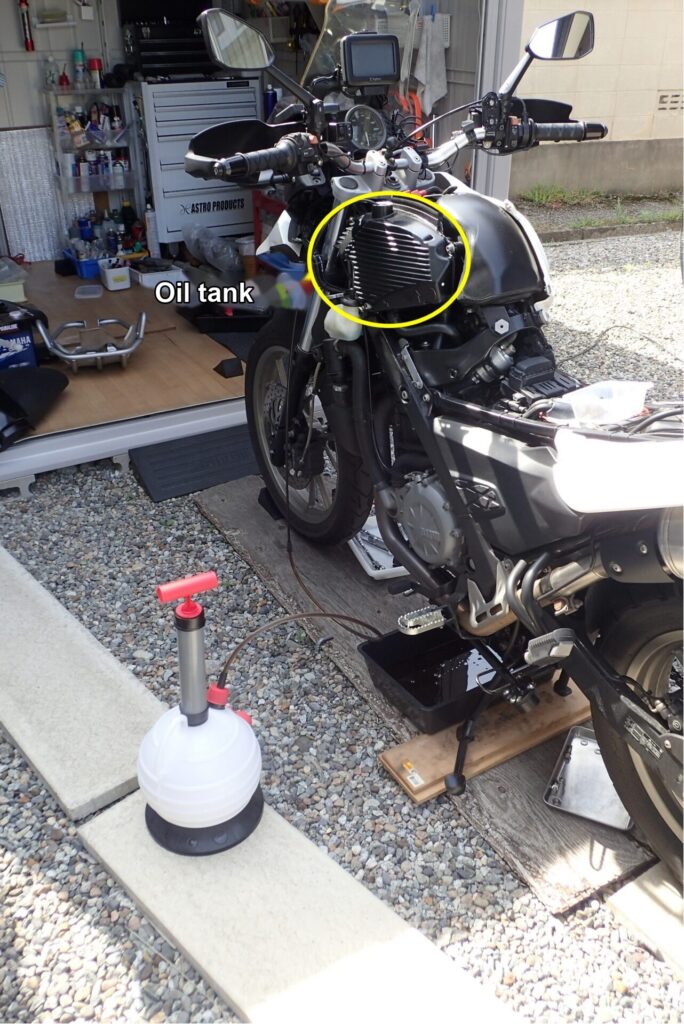
The G650GS is dry-sump, so there's an oil tank where the yellow circle is in the photo above.
An oil change means draining the oil from this tank as well.
The repair manual says to drain it by removing the oil tank drain bolt.
This time, though, I sucked the oil out through the filler with an oil extractor.

Working the pump by hand creates a vacuum.
You can see the oil being drawn through the clear hose into the round container.

While the vacuum draws the oil out, I get the new gasket and oil filter ready.
The gasket is a Daytona one.

The oil filter is a Kijima one.

Meanwhile, oil had stopped coming out of the drain.
Fit a new gasket and refit the oil drain bolt.

Tighten the oil drain bolt with a torque wrench.

Next comes the oil filter.
The oil filter sits inside the black round part in the photo above.
You just have to remove it, but it's obvious that oil will dribble out and mess up the engine when you do.
So I cut up a plastic drinks bottle to keep the dribbling oil off the engine.
(To give away the ending: even with this, a little oil still got onto the engine.)

I cut the bottle to shape while holding it up against the engine.
I tried to take a photo that shows the shape, but it doesn't really come across, does it?

The oil filter cover is off.
In the photo, oil is dribbling neatly out of the bottle's neck, but...

In reality the bottle couldn't catch all of it, and a little oil got onto the engine.

On the right is the genuine oil filter, and on the left the Kijima one.

Push in the new oil filter.
It fitted perfectly.

Don't forget to fit the O-ring to the oil filter cover.

Refit the oil filter cover.

The oil filter cover tightening torque is 10 Nm.

The sprocket cover tightening torque is 5 Nm.

The sprocket cover is back on, too.

This is the oil I'm using.
It's MAXIMA EXTRA4 15W-50.
It's an expensive oil, but I picked it up cheaply in a clearance sale.
Now let's compare the amount of oil that came out with the amount the repair manual says to put in.
When I measured the oil I'd drained, it came to:
- From the drain bolt under the engine: 0.6 L
- From the oil tank: 1.5 L
- From the oil filter housing: about 0.1 to 0.2 L
Total drained: 2.2 to 2.3 L
According to the repair manual, the oil to put in is as follows.
- First pour 1.7 L in through the oil filler.
- Then let the engine idle for 30 seconds.
- Then add another 0.6 L through the oil filler.
With an oil filter change: 2.3 L
So the amount drained and the amount to put in were almost the same, and I called the job done.
Of course, after refilling I rode a short distance and then checked the level with the dipstick as well.

Refit the panels, engine guard and so on, and the job is done.