Changing the number of teeth on your motorcycle's sprockets changes the final (secondary) reduction ratio, so you can adjust how sharply the bike pulls away and how fast the engine turns when cruising on the motorway.
As a rough guide, one tooth at the front equals about 2.5 to 3 teeth at the rear. A smaller ratio (taller gearing) lowers the cruising revs; a larger ratio (shorter gearing) gives quicker acceleration.
In this post I go through how to calculate the final reduction ratio and what to watch out for, then share how my BMW G650GS rides after going three teeth taller at the rear, from 47T to 44T (cruising, clutch control when pulling away, and the Japanese roadworthiness test).
[My example] Changing the rear sprocket on a BMW G650GS from 47T to 44T
On my BMW G650GS (652 cc single), I changed the rear sprocket from the standard 47T to 44T (three teeth fewer), making the final drive taller.
The reason: I use the bike mainly for touring, and with the standard 47T the engine felt like it was revving too high. The front sprocket is still the standard 16T; I only changed the rear.
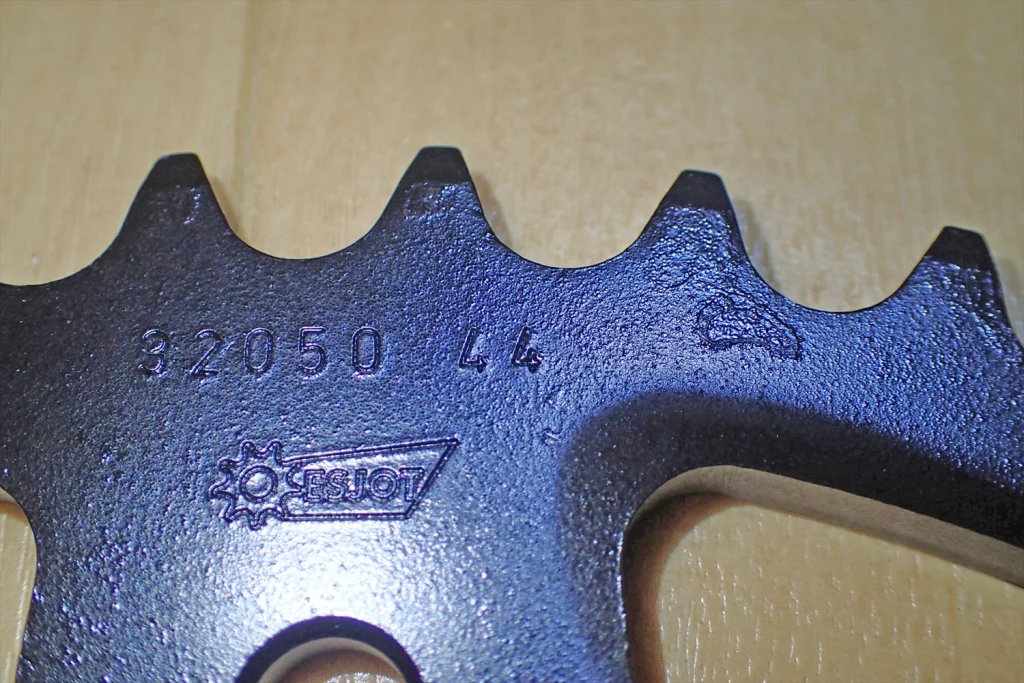
The sprocket I fitted is a 44T from ESJOT of Germany.
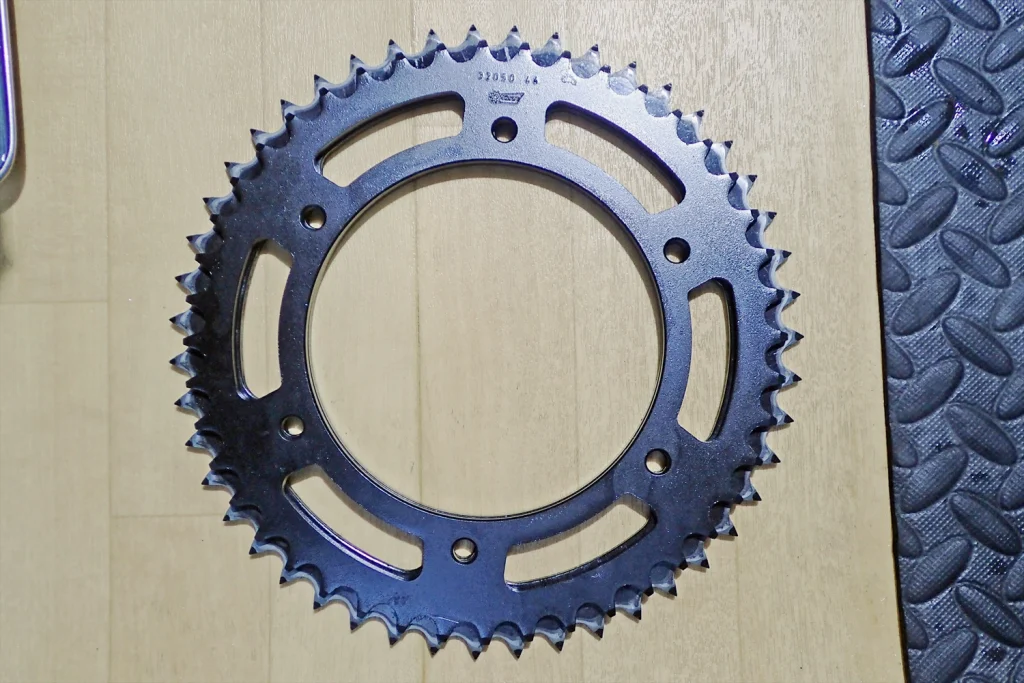
I laid the 44T over the standard 47T sprocket and took a photo. It's only three teeth, but the diameter is smaller than I expected.
With a smaller diameter, less chain moves per turn of the rear wheel, so at the same engine speed the bike goes faster.
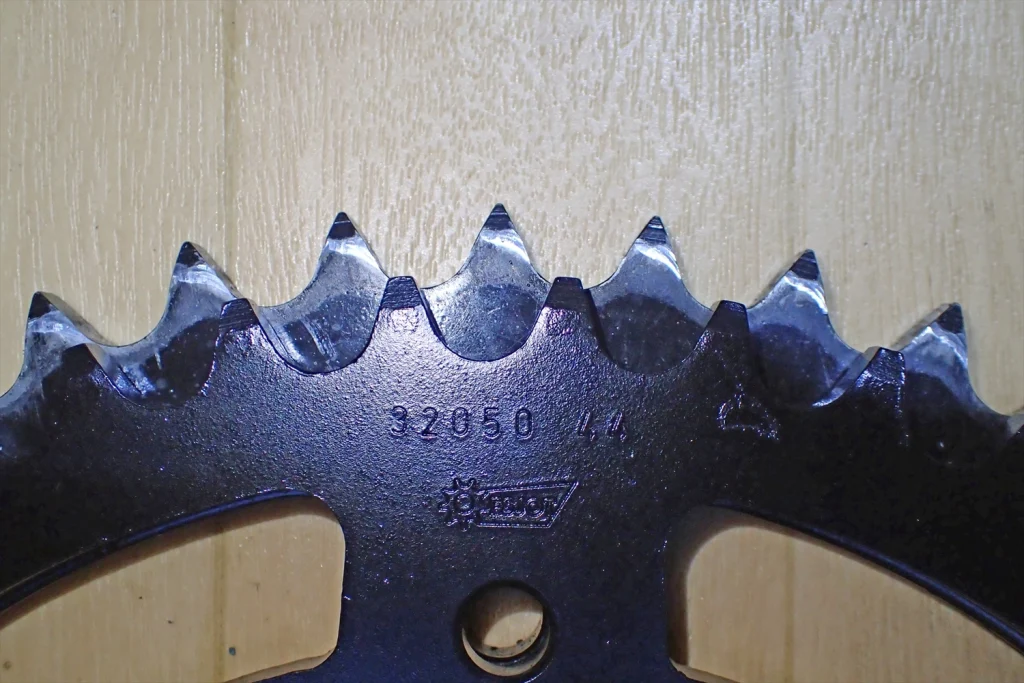
The old 47T (behind) and the new 44T (front) have differently shaped teeth; the old 47T teeth look pointed.
Pointed or unevenly worn sprocket teeth can shorten chain life, so when you're thinking of changing the gearing, it's also a good time to look over the whole drive train.
How it rides: motorway cruising, town riding and pulling away
Here's how it felt after going from 47T to 44T (this is just my impression, with my riding style).
- Motorway cruising: The bike reaches the same speed without revving as hard as before, so cruising on the motorway is easier.
- Town riding: In town, too, the bike gets up to speed without revving as hard as before.
- Pulling away (clutch control): When pulling away from a stop, I find myself paying a tiny bit more attention to slipping the clutch, but only just (I don't think you'd notice unless someone told you).
Overall I'm glad I changed it, but I feel the in-between option, 45T (two teeth fewer), might be even better.
Speedometer error and the roadworthiness test
When you change the gearing, the worries are speedometer error and whether the bike will pass its roadworthiness test (shaken, Japan's equivalent of an MOT).
I took my BMW G650GS to the test still fitted with the 44T, and had the speedometer checked (measured at 40 km/h). It passed without any problem.
I think this is because the G650GS detects road speed from the wheel rather than from the gearbox (this is my guess).
If the speed is picked up directly from the wheel, changing the sprocket ratio won't throw the speedometer off. (*On bikes that measure speed at the gearbox, changing sprockets does cause speedometer error. More on the difference below.)
For the actual rear sprocket replacement steps and tools, see this post (in Japanese).
How sprocket changes work: calculating the final reduction ratio
Changing sprocket sizes adjusts the final reduction ratio, the last gear ratio between the engine's power and the rear tyre.
The final reduction ratio formula
The final reduction ratio is calculated as follows.
Final reduction ratio = rear (driven) sprocket teeth ÷ front (drive) sprocket teeth
When this number changes, the bike's character changes like this.
- Larger number (shorter gearing): More acceleration. The engine revs higher for the same speed.
- Smaller number (taller gearing): Geared for top speed and cruising. The engine revs lower at the same speed.
Quick reference: how front and rear sprocket changes alter the ratio
Taking the BMW G650GS (standard: 16T front / 47T rear) as the baseline, here are the final reduction ratios and the percentage change for different sprocket sizes.
| Front (drive) | Rear (driven) | Final ratio | Change from standard | Effect |
|---|---|---|---|---|
| 16T (standard) | 47T (standard) | 2.938 | Baseline (0.0%) | Standard |
| 16T (standard) | 45T (2 fewer) | 2.813 | -4.3% | Slightly taller, for relaxed cruising |
| 16T (standard) | 44T (3 fewer, my bike) | 2.750 | -6.4% | Taller, for cruising |
| 15T (1 fewer) | 47T (standard) | 3.133 | +6.7% | Shorter, for acceleration |
| 17T (1 more) | 47T (standard) | 2.765 | -5.9% | Taller, for cruising |
As the table shows, going three teeth down at the rear to 44T (ratio 2.750) gives almost the same change (about -6%) as going one tooth up at the front to 17T (ratio 2.765).
Front or rear: which should you change?
Whether to change the front or the rear is a trade-off between cost and how finely you can adjust.
- Front sprocket (drive side): Cheap, and one tooth equals about 2.5 to 3 teeth at the rear, so the change is big. Good if you want a bold change at low cost.
- Rear sprocket (driven side): Lets you fine-tune one tooth at a time. With more teeth than the front, each tooth makes a smaller change, which suits precise tweaks such as "I just want the revs a little lower". There are also plenty of aftermarket rear sprockets in aluminium alloy or with eye-catching designs.
Three things to check before changing sprockets
Changing sprocket sizes is a bolt-on way to change how the bike behaves, but it comes with these physical and legal limits.
1. Speedometer error and the roadworthiness test
Speedometers broadly pick up road speed in one of two ways.
- Wheel speed sensor (wheel-based): Detects rotation at the front or rear wheel, or from the ABS sensor. As long as the wheel diameter doesn't change, changing the sprocket ratio causes no speedometer error.
- Gearbox-based (output shaft): Detects speed from the engine's output shaft. Change the ratio and the actual speed and the indicated speed no longer match.
On a bike with gearbox-based sensing, a big change in ratio risks failing the speedometer check at the roadworthiness test (the error between actual and indicated speed must be within the limits). If your bike shows an error, you may need a speedo correction device (such as a SpeedoHealer). Check how your bike measures speed before you start.
2. Chain length (number of links) and adjuster range
Changing sprocket sizes changes the chain length you need.
- Fewer teeth: The chain is effectively longer, and even with the swingarm adjusters pulled fully back you may not be able to reach the specified chain slack.
- More teeth: The chain is too short: the axle won't go far enough forward, or the chain won't fit at all and you need a new, longer chain (more links).
With a small change of two or three teeth at the rear, it may stay within the adjuster range, but always check the chain for uneven stretch and how much adjustment you have left before you start.
3. Clearance with surrounding parts
As the sprocket diameter changes, it may hit nearby parts.
- Bigger front (or smaller rear): Check there's enough clearance inside the sprocket cover and no contact with the crankcase.
- Bigger rear: The sprocket rim and chain may touch the chain guard or the inner mudguard.
Summary and the parts I used
Changing sprocket sizes doesn't fundamentally change the bike's power, but it's an effective way to match engine speed and road speed to the way you tour.
- To lower cruising revs and reduce vibration on the motorway: taller (fewer rear teeth / more front teeth)
- To improve acceleration from a stop and on hills: shorter (more rear teeth / fewer front teeth)
- Before changing, check chain length, where the speed sensor is, and the clearance around the sprockets
The maker must have considered the standard sprocket sizes very carefully. If you change them, match the change to how you use your bike, check that it's safe, and do the work at your own risk.
The sprocket I used for the 44T conversion on my G650GS was an ESJOT 44T steel sprocket (stamped 32050 44).
Before the swap, I compared the old 47T rear sprocket (25,000 km) with the new 44T. Here's the sprocket wear and the replacement itself: