Hello everyone, Boo here.
Today I adjusted the chain alignment on my motorcycle.
The bike is a BMW G650GS.
Most motorcycles use a chain to send the engine's power to the rear wheel.
So if the chain is not lubricated enough, or is not fitted properly (the chain alignment is out), the engine's power doesn't reach the wheel fully, fuel economy gets worse, and the chain and sprockets wear out sooner.
That is why chain maintenance matters.
This post is about chain alignment; for chain lubrication, see my other article (in Japanese).
Today I'll show how to adjust chain alignment, using the G650GS as an example.
Adjusting chain alignment means making sure the chain and the front and rear sprockets are in a straight line.
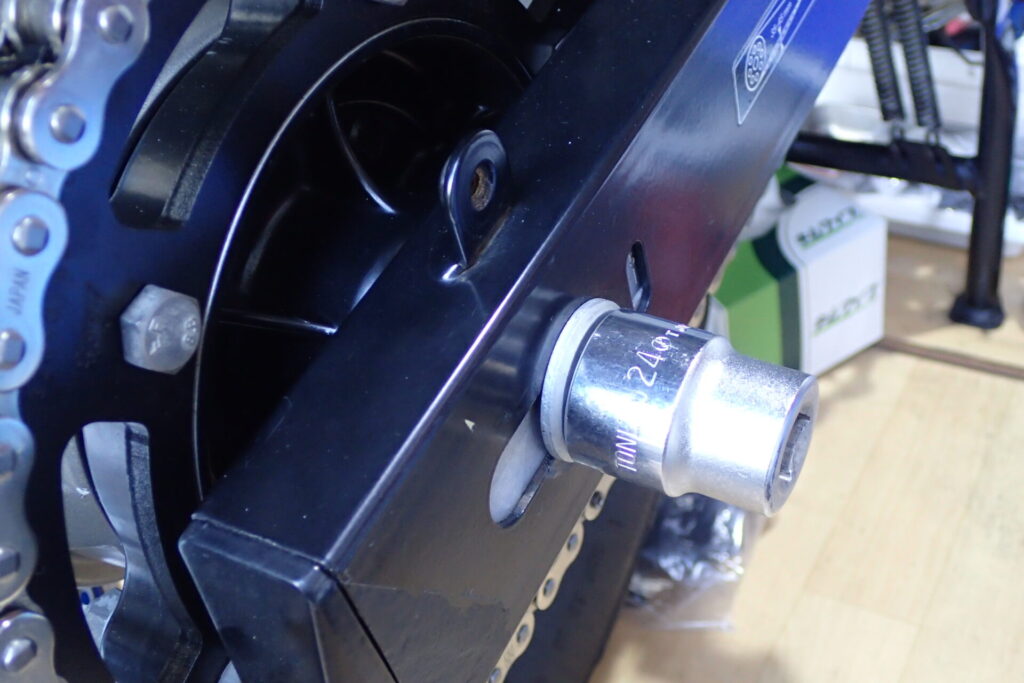
Straight away, here is a photo of the area around the rear wheel.
To adjust the chain alignment, you need to loosen the rear axle.
On the G650GS, you need a 24 mm socket or spanner (across flats) on the right and a 19 mm one on the left to loosen the axle.
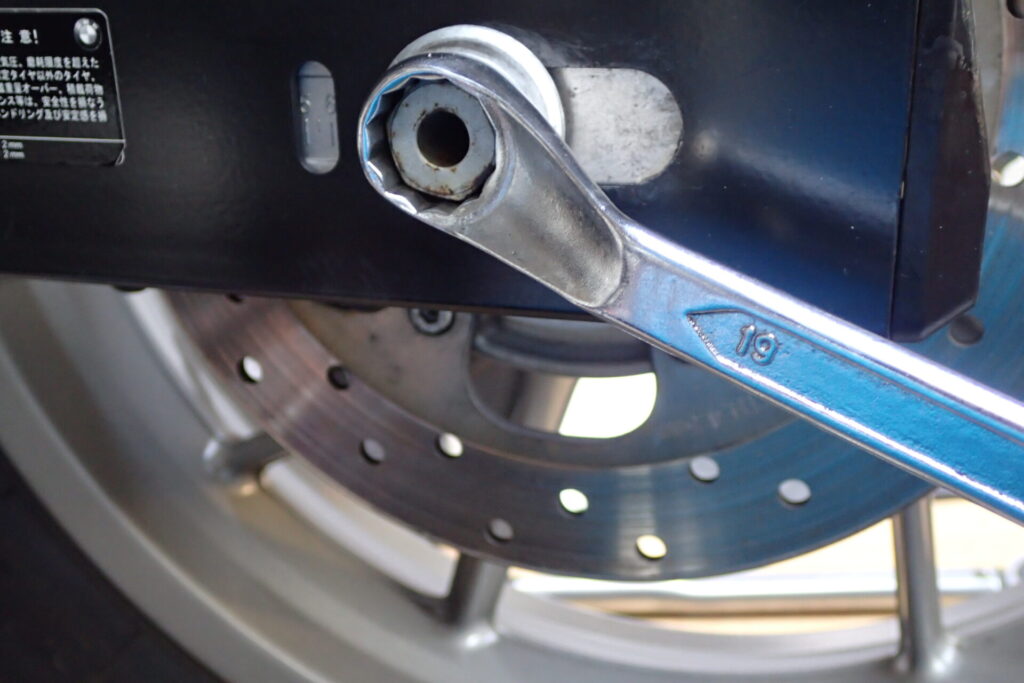
Loosen the rear axle.
You only need to loosen the axle; you don't need to remove it.
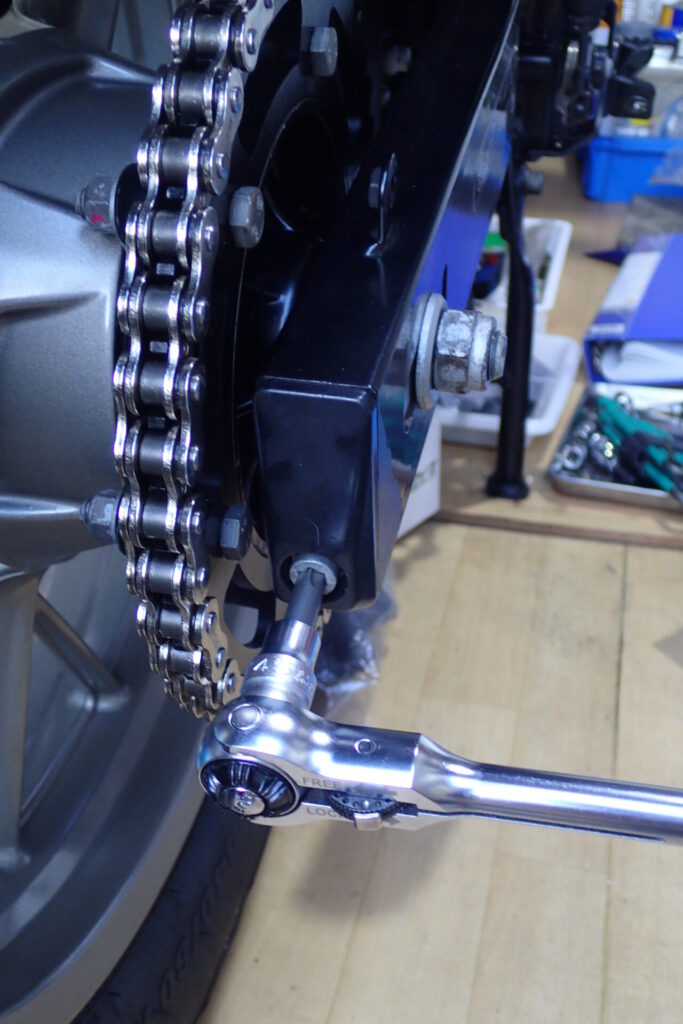
Once the axle is loose, you can adjust the chain tension with the adjuster bolts.
On the G650GS, tightening the bolts in the photo above (one on each side, two in total) tightens the chain, and loosening them slackens it.
But this time we are adjusting the chain alignment, so, as I said above, we adjust so that the front and rear sprockets and the chain are in a straight line.
In other words, you adjust the angle of the rear sprocket by tightening or loosening the chain adjuster bolts.
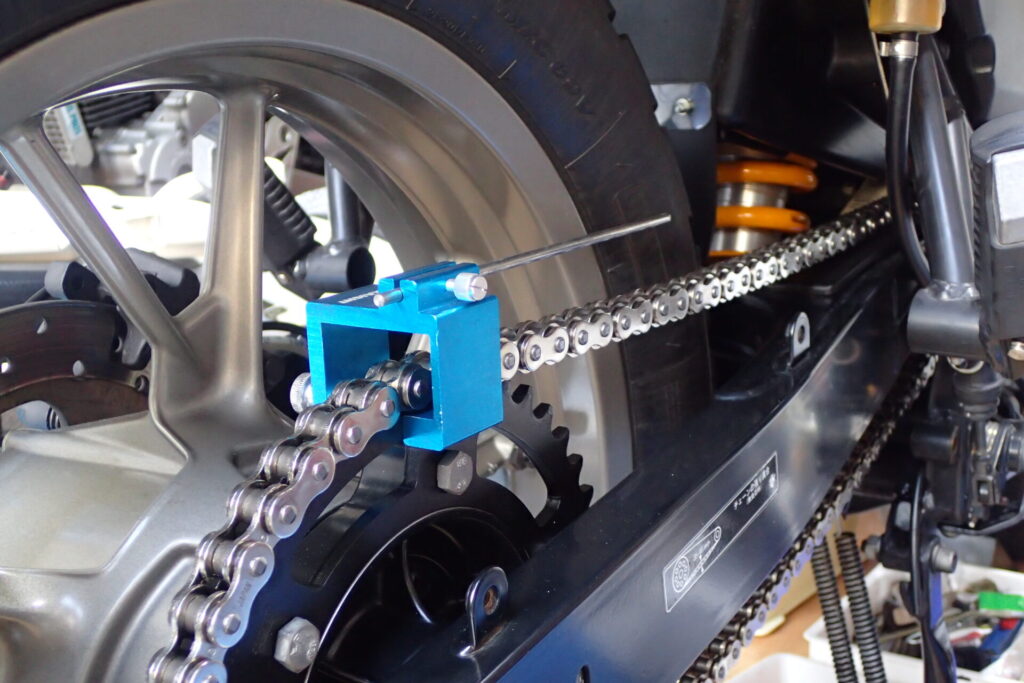
To adjust the chain alignment, I used the tool in the photo above (the blue one with a long thin rod).
It is called a chain alignment tool, and several makers sell one.
Some people check it by eye instead, from some way behind the bike, without a tool.
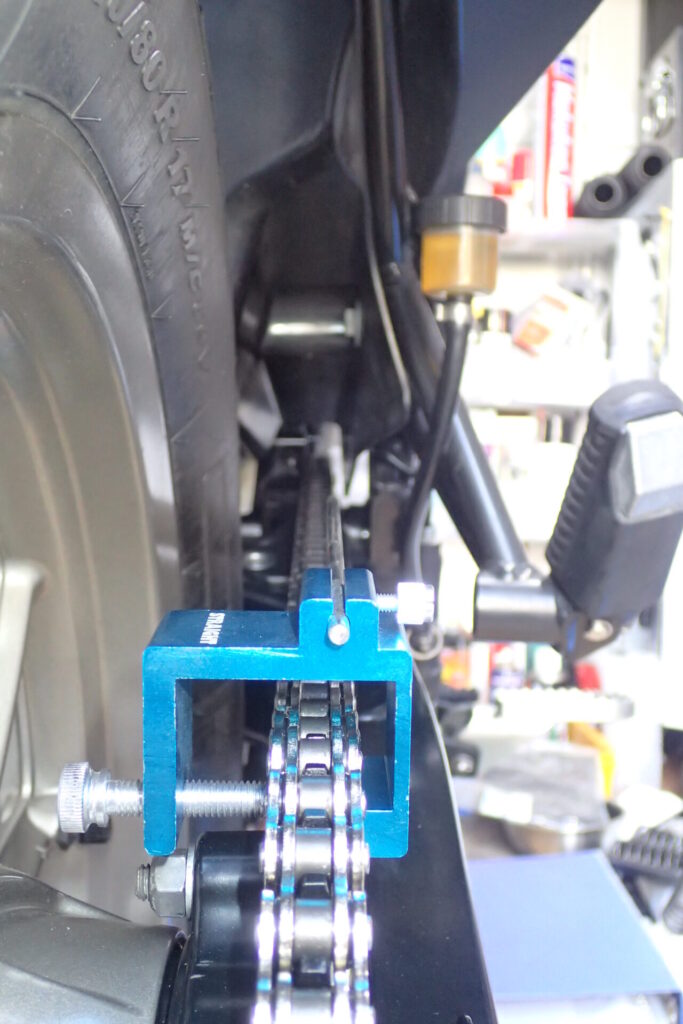
Use the chain alignment tool as in the photo above.
Check whether the rod of the tool is parallel with the chain.
In the photo above, the rod seems to point slightly to the right.
Adjust to correct this angle.
Once the chain alignment is set, tighten the axle to the specified torque and you're done. The repair manual (BMW F650GS repair manual, which also covers this engine and chassis family) gives 100 Nm for the axle.
When I tightened the axle nut, the axle went slightly crooked and the chain alignment shifted, so I had to re-tighten it several times.
When you tighten the nut, keep checking that the alignment you set doesn't shift.
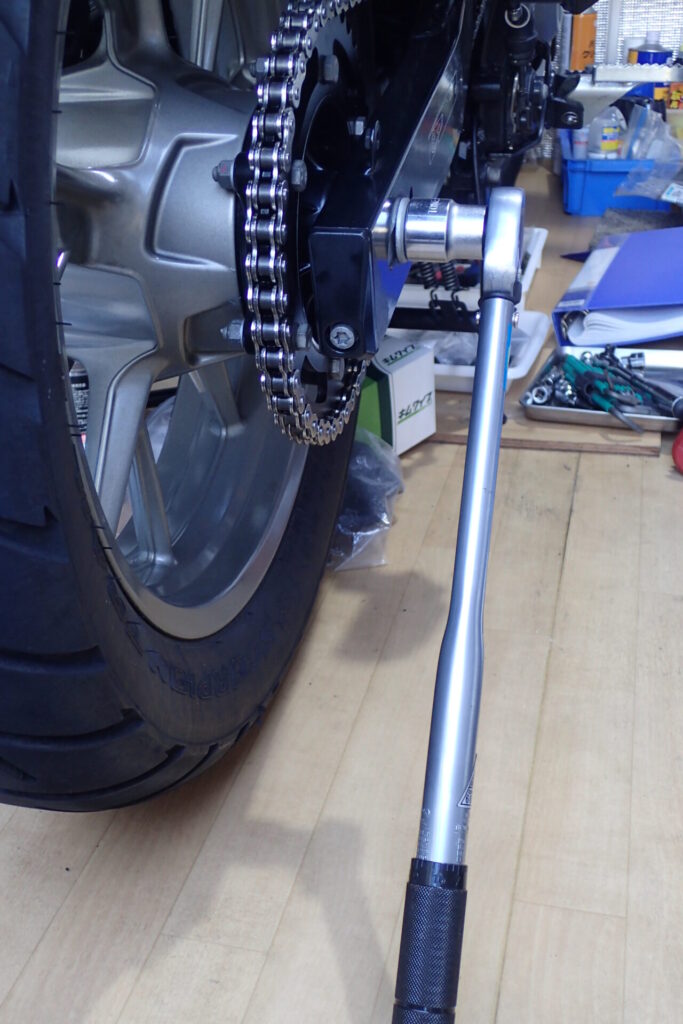
Once the nut is tightened to the specified torque, the job is done.
Then refit the chain guard and any other parts you removed.
I think everyday maintenance helps you notice problems with your bike early, keeps it in good condition, and leads to better safety and fuel economy.