Hi everyone.
This is my suspension series, where I strip down the front forks of my secondhand Honda XR250 (the Japan-market XR250 BAJA / MD30).
- [Part 1: Teardown and First Clues] (From the outer shape and the bottom adjuster, I guessed that the forks were ME08 parts.)
- [Part 2: Full Teardown and Parts Comparison] (I stripped the forks completely with a special tool and confirmed that they had aluminium cylinders.)
This is Part 3, the final part of the series: a close look at the cylinders and the damping parts.
This time, I measured and compared the deepest core parts that I took out in Part 2. With detailed photos, I explain the two clearest differences between the road bike (MD30) and the enduro racer (ME08): the length of the damper cylinder, and a damping part at the tip of the piston rod that the MD30 simply doesn't have.
The forks on my bike turned out to be XR250R (ME08) parts. If you own an XR250R, these are the same type of forks as yours. If you ride an MD30, this shows you what the racer forks have inside that yours don't. In this part, you will see exactly where the difference in suspension performance comes from.
1. Damper Cylinder Length: An Important Difference for Stroke and Oil Level
First, I laid the two damper cylinders (cylinder pipes) side by side. These are the heart of the front fork, and I took them out in Part 2.
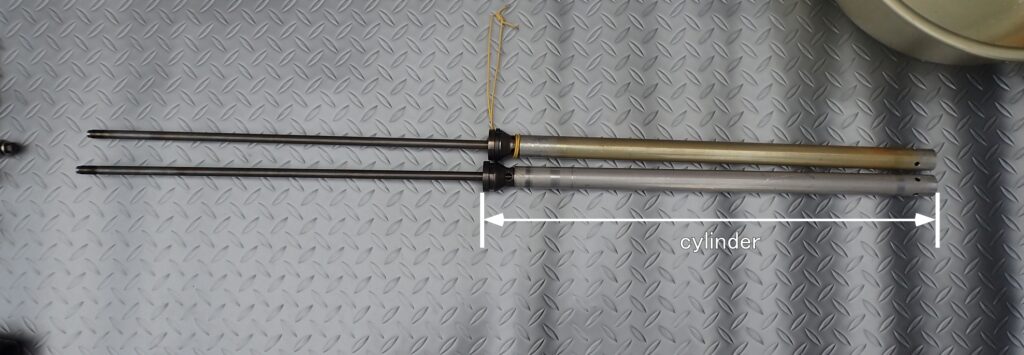
The top one is the steel cylinder (gold) from the road-legal MD30. The bottom one is the aluminium cylinder (silver) from the racer, the ME08.
As you can see at a glance, the material and colour are not the only differences. The overall length of the cylinder itself (the part marked "cylinder" in the photo) is clearly different. The cylinder on the racer, the ME08 (bottom), is designed to be longer.
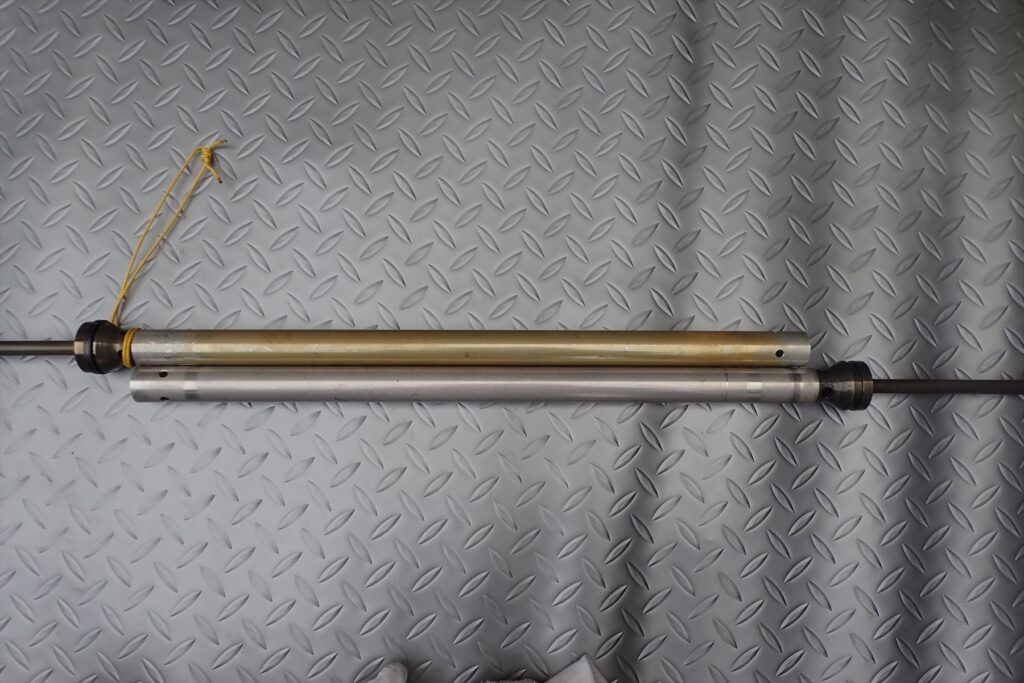
When I staggered the two cylinders, the difference in length was even easier to see.
A different cylinder length means a different effective stroke for the piston that moves inside the inner tube, and a different internal volume inside the fork. In other words, this is clear proof that the specified oil volume and the specified oil level for an overhaul are completely different from the figures in the MD30 service manual.
2. Build Details: Different Shapes at the Top of the Cylinder
Next, I took a close look at the joint at the top of each cylinder (the end where the inner rod comes out).
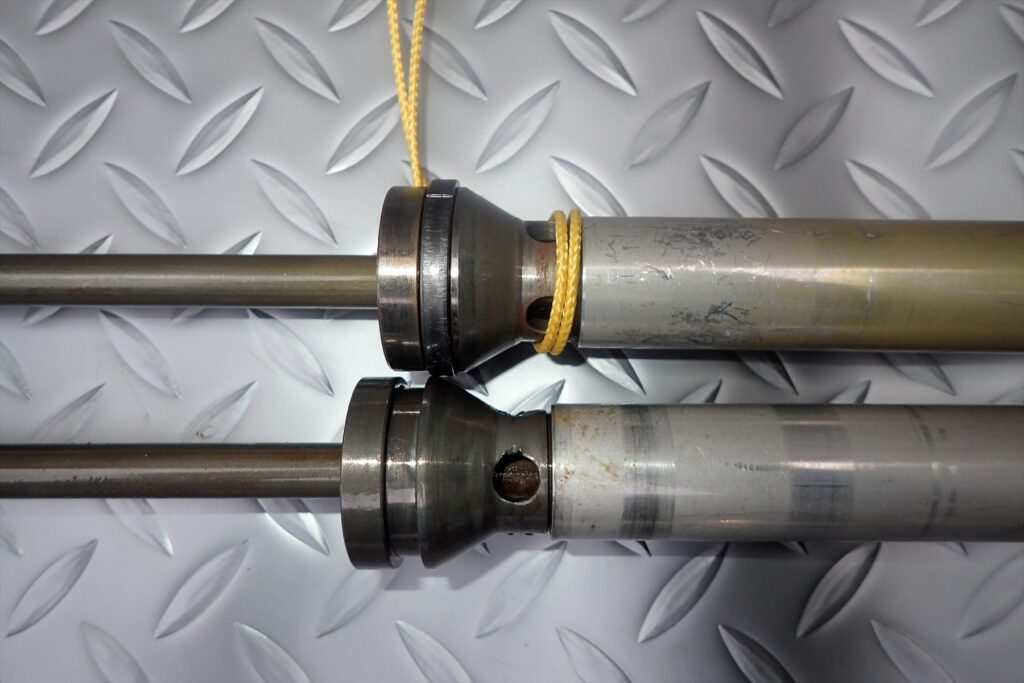
The top one is the MD30, and the bottom one is the ME08. The shape of the side ports (holes) that the oil flows through is completely different. So is the quality of the machining on the tapered section that fits against the top cap.
The ME08 racer part (bottom) has more precise lightening cuts and smoother shapes. I think this is to let the oil flow smoothly even under heavy impacts, and to make cavitation (the formation of air bubbles) less likely.
3. Measuring the Exact Length with a Carpenter's Square
To put a number on the difference in cylinder length, I measured it accurately with an L-shaped steel carpenter's square. Recording small measurements like this is very important if you want your DIY work to be reliable.
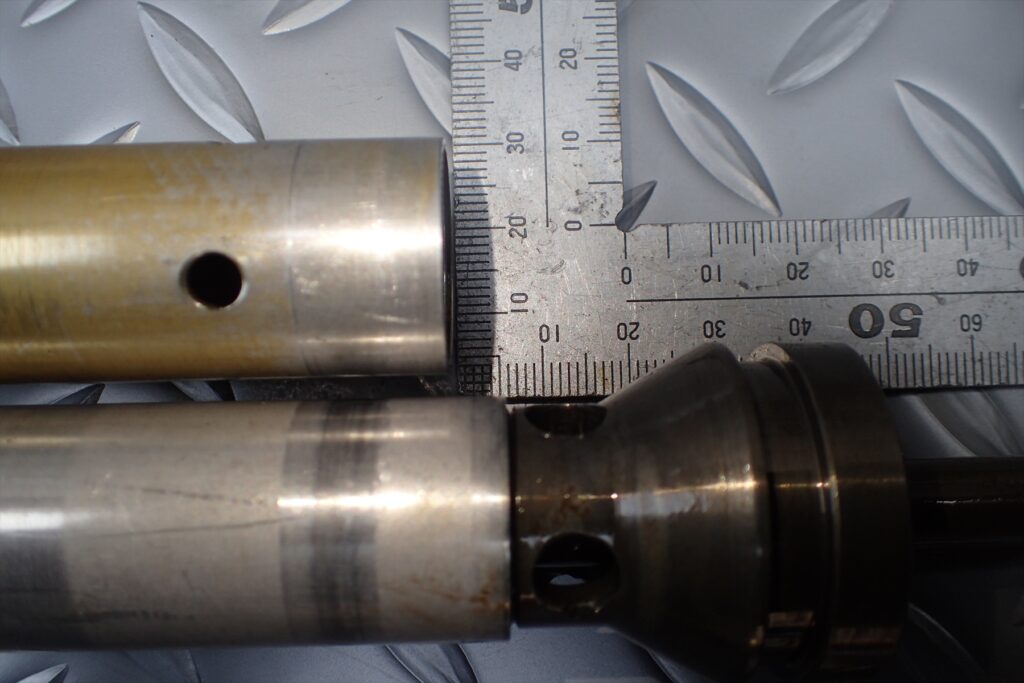
I lined up the left ends of the two cylinders exactly (as the reference point) and measured at the right ends. The ME08 cylinder body turned out to be about 5 mm longer than the MD30 one.
I think this 5 mm is what creates the difference in overall fork length, and in turn the difference in stroke and ground clearance.
4. The Big Surprise: A Damping Part on the Piston Rod Tip That the MD30 Doesn't Have
And here is the biggest highlight of this teardown, and the thing that surprised me most. When I took apart and examined the tip of the piston rod (the piston valve section that sits inside the cylinder), an unexpected part appeared.
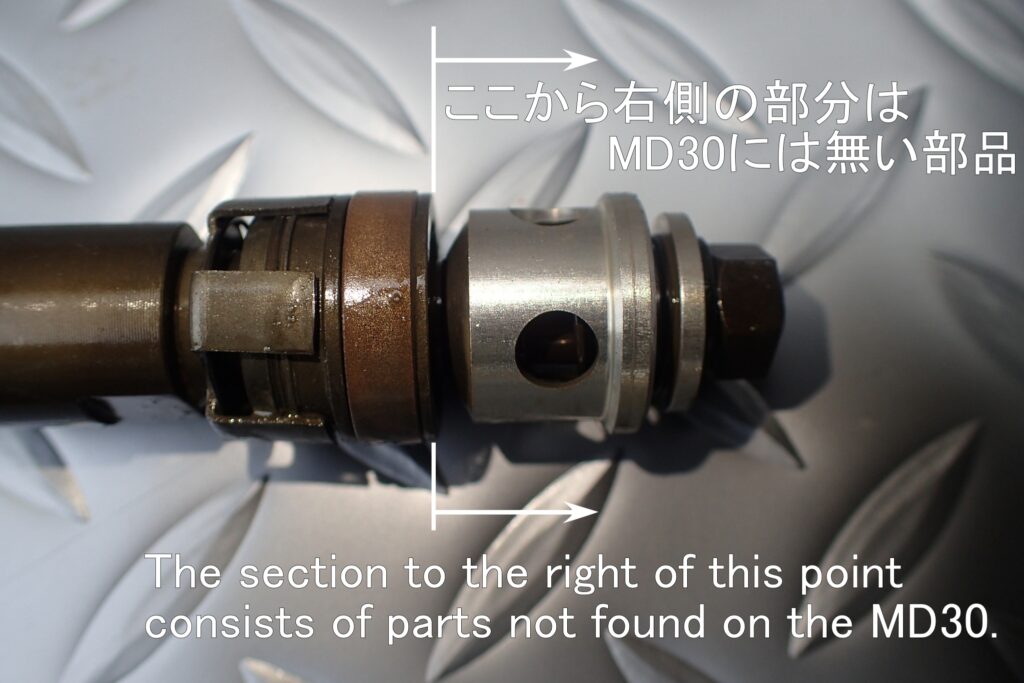
Look at the section to the right of the white line in the photo (the tip). This is where I found parts (a damping mechanism) that are unique to the ME08 and don't exist on the MD30.
I believe this is an extra unit made up of a rebound piston valve and a shim stack, which fine-tunes the damping force as the fork extends (on rebound).
(The compression adjuster is at the bottom of the fork leg, so I guessed that this part works on the rebound side.)
I think that on the road-legal MD30, this area has been simplified to put cost, durability and a supple ride on the street first. The ME08 racer, on the other hand, comes with this complex mechanism as standard, probably to make the front wheel follow the ground as closely as possible.
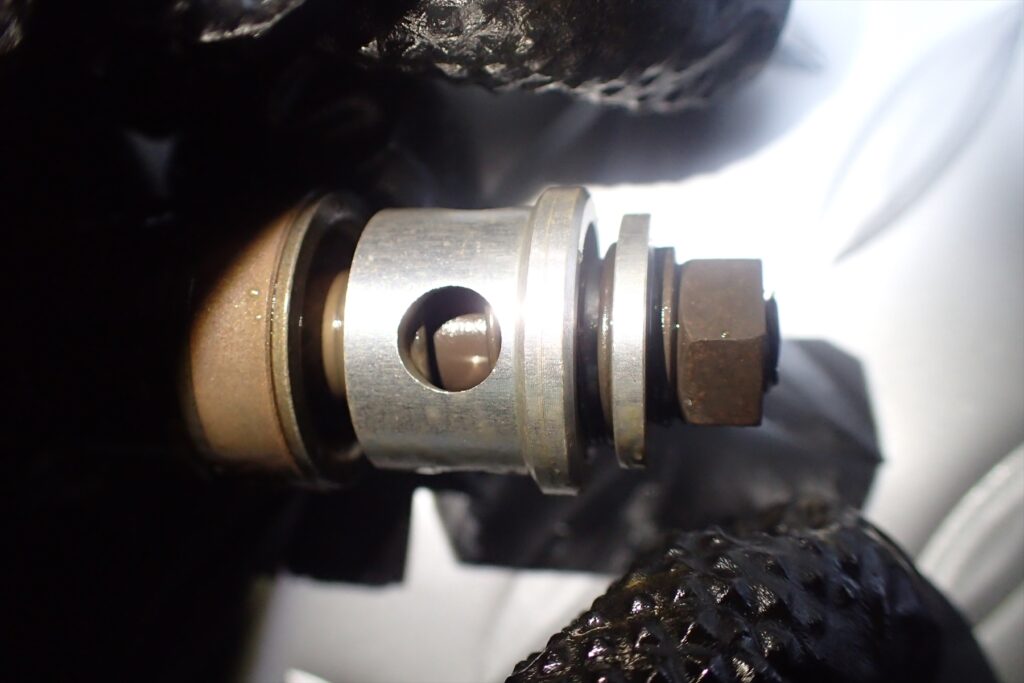
Here is a closer look at this extra damping mechanism. You can see that the precisely machined aluminium part has neatly drilled ports (holes) for the oil to pass through.
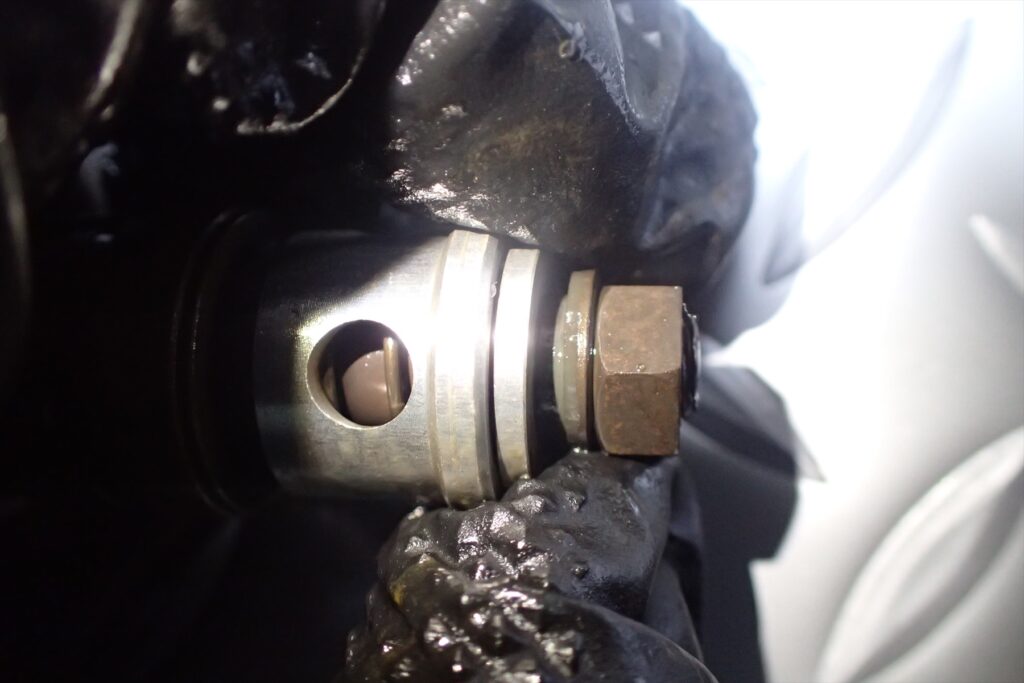
The tip of this part is pushed out by a spring, and it moves when you press it with your finger (photo above). From this, I assume that when the piston rod moves down (on compression), the tip moves as shown in the photo above, and when the piston rod moves up (on rebound), the oil passes through the round holes.
Summary: Looking Back on the Three Parts, and My Plan to Overhaul the Forks
What did you think of this three-part series on stripping down the XR250 front forks and checking the ME08 racer forks?
This happy surprise only came my way because I bought a secondhand bike. I stripped the forks completely and saw two things with my own eyes: the length of the internal cylinders, and the refined mechanism, which I believe is a rebound valve, that the MD30 doesn't have. That convinced me how much potential this racer suspension has.
However, with parts this different in shape and size, one thing is now certain: when I overhaul these forks, I must set the fork oil volume and the oil level (the distance from the top of the inner tube) to the ME08 racer specification in the XR250R manual.
Enjoy your riding!