"I often hear that motorcycle helmets only have a three-year lifespan, but do I really need to replace such an expensive helmet that often?"
"It still looks spotless, and I've never dropped it, so isn't it still perfectly safe to use?"
Plenty of riders hold onto the exact same helmet for years while wrestling with these questions.
Honestly, I was one of them. Just recently, I took out the interior comfort padding of my long-trusted SHOEI GT-Air premium touring full-face helmet to wash it. When I looked at the production label stuck inside, I was completely stunned.
Printed right there were the words: "Manufactured: 2017/03."
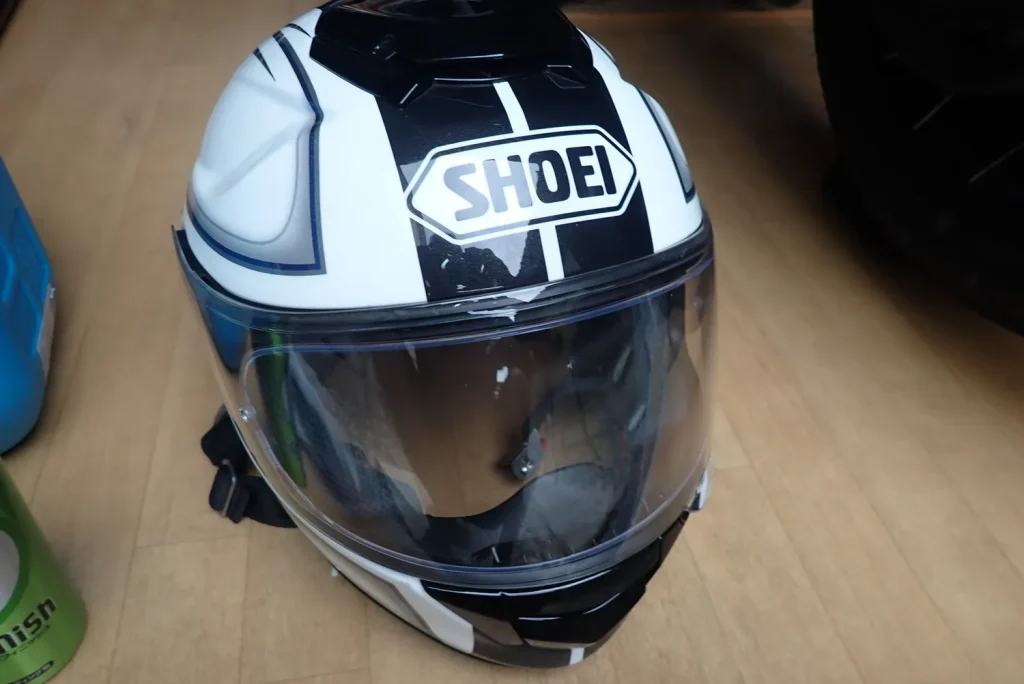
Before I knew it, almost ten years had passed since I bought it. I had never been in a crash, nor had the helmet taken any hard hits, so it had always felt completely comfortable. But in this aged condition, could it actually protect my head if the worst happened?
Here's the bottom line: no matter how pristine a helmet looks on the outside, continuing to ride with one that is nearly a decade past its manufacture date is extremely dangerous.
In this article, I will break down the scientific reasoning behind the "three-year replacement cycle" recommended by major Japanese helmet manufacturers (SHOEI and Arai), the crucial structural differences when compared to budget helmets (such as Kabuto and other entry-level options), the real-world value of a built-in inner sun visor on mountain touring rides, and SHOEI's upcoming domestic price adjustment in Japan scheduled for October 2026 (which bundles the P.F.S. custom fitting fee into the base MSRP)—all from my perspective as a rider who does my own maintenance.
[Featured Helmet for Review and Comparison]
SHOEI GT-Air 3 A premium touring full-face helmet equipped with an instant-deploy inner sun visor for sudden changes in lighting, top-tier noise reduction, and an exceptional custom fit through SHOEI's P.F.S. (Personal Fitting System).
1. Why Do Manufacturers and the SG Standard in Japan Recommend Replacing Helmets Every 3 Years?
Whenever you research the expected lifespan of a motorcycle helmet in Japan, you will inevitably run into the exact same benchmark: "three years from the date of first use."
Why is such a short timeframe recommended? While some riders suspect this might just be a marketing ploy by manufacturers to sell more gear, there is a very solid, scientific safety reason behind it.
The Validity Period of Japan's SG Mark and Liability Compensation
The vast majority of motorcycle helmets sold domestically in Japan carry an "SG Mark" issued by the Consumer Product Safety Association. This mark includes third-party bodily injury liability insurance in the rare event that a physical defect in the helmet leads to personal injury.
The legal and regulatory foundation of Japan's 3-year replacement recommendation is directly rooted in the fact that this SG Mark insurance coverage is valid for exactly three years from the date of purchase.
(Context note: Unlike Japan's SG Mark, which ties the 3-year rule to third-party injury compensation, international guidelines such as the Snell Memorial Foundation generally recommend replacement within five years of regular use or seven years from manufacture.)
The Three Decisive Factors Behind Helmet Degradation
A helmet does not protect your head through its outer shell alone. What directly cushions your skull is the structural system built into the interior.
1. Hardening and Degradation of the EPS Liner:
The expanded polystyrene (EPS) liner housed inside the outer shell absorbs catastrophic impact energy by progressively crushing itself in a crash, thereby reducing the shock transferred to your brain. Over time, however, this EPS liner inevitably hardens and loses its elasticity. It degrades due to exposure to exhaust fumes in oncoming wind, UV sunlight, atmospheric humidity, and the continuous absorption of sweat and natural body oils from your skin on every single ride.
2. Breakdown and Compaction of the Urethane Interior Foam:
Over years of regular riding, the urethane comfort foam padding gets crushed and permanently loses its rebound cushion. When a helmet no longer hugs your head snugly and develops play, it can violently shift or fly off completely during a crash. Worse, your head can slam around inside the hard shell, causing severe traumatic brain injuries.
3. Structural Fiber Degradation of the Chinstrap:
The heavy-duty nylon webbing of the chinstrap, as well as the steel rivets securing it to the shell, steadily lose their tensile strength through years of UV exposure and corrosion from the salt in your perspiration.
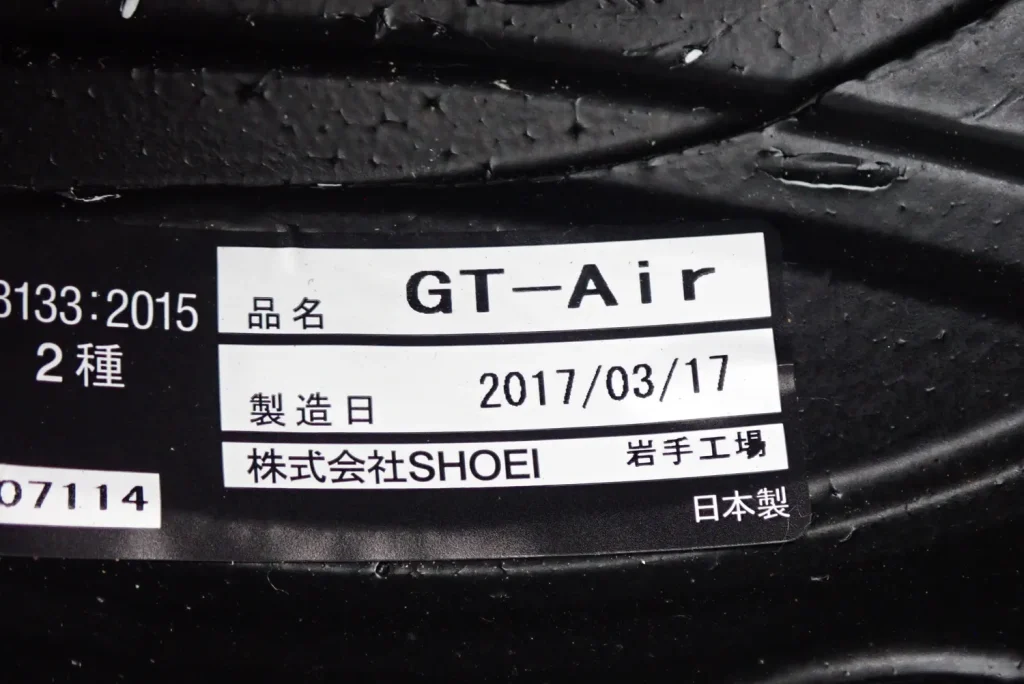
My own SHOEI GT-Air was manufactured in March 2017, meaning it has already surpassed the manufacturer's recommended lifespan by nearly triple. Even when the outer composite shell has not a single scratch on it, as riders, we have to face the hard truth: the internal EPS liner can no longer deliver anywhere near its engineered impact protection.
2. What Sets Budget Helmets and Kabuto Apart from Premium Brands Like SHOEI & Arai?
When shopping for a motorcycle helmet, plenty of riders wrestle with the massive price gap between budget helmets retailing around ¥10,000 to ¥20,000 (including mid-range offerings from OGK Kabuto) and premium flagships from SHOEI and Arai running ¥70,000 to ¥90,000.
This stark price difference is definitely not just paying for a prestigious brand logo. Real, undeniable performance gaps exist in three core areas: outer shell materials, aerodynamics and noise suppression, and certified safety standards.
| Comparison Point | SHOEI & Arai (Premium Flagships) | OGK Kabuto (Mid-Range Contenders) | Budget Helmets (¥10,000–¥20,000) |
| Shell Material | High-strength multi-composite fiber laminates (FRP / AIM / PB-cLc) | Polycarbonate / Multi-fiber FRP on select models | Basic injection-molded ABS resin |
| Penetration Resistance & Rigidity | Exceptionally high; allows shells to be made thin, stiff, and lightweight | Properly tuned rigidity to meet standard certifications | Relies on thicker plastic to gain rigidity, resulting in a heavier helmet |
| Aerodynamics & Noise Reduction | Wind tunnel tested in-house to drastically cut buffeting and wind roar | Outstanding aerodynamics (featuring patented Wake Stabilizers) | Significant wind roar; prone to head buffeting at highway speeds |
| Interior Comfort & Liner Quality | Moisture-wicking, anti-bacterial fabrics with micro-customization | Highly practical, comfortable, and durable for daily commuting | Abrasive feel; foam padding collapses and breaks down quickly |
| Safety Standards (Japan) | Strict JIS Class 2, SNELL certified (Arai and select models) | Strict JIS certified on most models | SG Mark and mandatory PSC only (bare minimum road-legal baseline) |
(Safety standard note: JIS Class 2 refers to Japanese Industrial Standards for highway-rated motorcycle helmets. PSC is the mandatory legal baseline for public roads in Japan, while the SG Mark is an independent standard accompanied by consumer liability insurance. SNELL certification is recognized worldwide.)
The Decisive Difference: Multi-Composite Fiber (FRP) vs. Injection-Molded ABS
Most budget helmets are manufactured from injection-molded ABS resin, where molten plastic is injected directly into a mold under pressure. While this method is inexpensive and perfectly suited for mass production, ABS plastic is inherently brittle under concentrated shock and degrades significantly faster over time when exposed to UV radiation and environmental elements.
In contrast, premium shells—exemplified by SHOEI's AIM/AIM+ and Arai's PB-cLc—are constructed from complex matrices of high-tensile fiberglass and advanced organic synthetic fibers, carefully hand-laid in overlapping layers by master technicians. This composite structure flexes with immense resilience to dissipate localized shock energy across the entire shell, providing unyielding resistance against sharp, penetrating impacts.
3. Why an Inner Sun Visor Is a Game-Changer for Touring—and Why Arai Refuses to Build One In
The single biggest reason I have stuck with my SHOEI GT-Air for so many years is the built-in inner sun visor that I can deploy and retract with a simple flick of a lever.
The Overwhelming Advantage I Experience on Mountain Touring in Gifu
I frequently go on touring rides through the winding mountain roads of Gifu Prefecture, a mountainous region in central Japan known for technical winding roads. When riding through mountainous terrain, you constantly run into extreme lighting shifts:
- Plunging from intense, blinding sunlight straight into a pitch-black, poorly lit tunnel
- Carving through mountain passes blinded by low, glaring evening sun
If you ride with a dark tinted shield, the moment you enter an unlit tunnel, your vision is instantly wiped out. To avoid crashing, you have to flip your shield wide open, leaving your eyes exposed and terrified of flying bugs or kicked-up road debris from oncoming traffic. On the other hand, if you wear sunglasses inside a clear shield, it is impossible to safely take them off while approaching a dark tunnel at speed.
With an inner sun visor, however, the very split-second you dive into a tunnel, you just flick the lever on the left side up with your gloved hand, and your view is instantly crystal-clear. The moment you pop out into the sunlight at the exit, you flick it right back down. Once you experience this peace of mind and lightning-fast adaptability, you can never go back to riding without one.
Why Doesn't Arai Build an Inner Sun Visor into Their Full-Face Helmets?
This brings up a question countless riders ask: "Why does Arai—revered worldwide for supreme helmet safety—refuse to build a single full-face helmet with an internal sun visor?"
The answer comes down to Arai's uncompromising, zero-concession safety philosophy.
1. Preserving the "R75 Shape" to Glance Off Impacts:
Arai stubbornly adheres to creating smooth, round, egg-shaped helmet shells with a continuous convex radius of at least 75mm (the R75 shape). Their philosophy is built on glancing off kinetic energy: rather than trying to absorb every direct blow, the smooth round shell glides over obstacles to deflect destructive rotational force away from your neck and brain.
2. Maintaining Uniform EPS Liner Thickness to the Millimeter:
Creating a cavity inside the shell to tuck away a retractable sun visor requires one of two compromises: you either have to shave down the internal EPS liner at the forehead to create space, or you have to swell the exterior shell outwards into an unnatural bulge. Arai stands firmly on the conviction that they will never sacrifice even a single millimeter of impact-absorbing liner thickness. Because of this unwavering standard, they refuse to integrate an internal drop-down visor.
Instead, Arai developed their own unique solution: the PRO SHADE SYSTEM, an external flip-down visor mounted on the outside of the main shield.
How to Choose Between These Two Philosophies
- SHOEI & Kabuto: These manufacturers engineer purpose-built shell geometries from scratch, satisfying rigorous safety certifications without compromising EPS liner density, delivering the undeniable real-world convenience of an internal sun visor.
- Arai: Arai places glancing-off capability above all else in any conceivable crash scenario, opting to provide sun protection strictly through an external shield system.
It is not a matter of which brand is objectively "better." It is a fundamental choice in design philosophy: do you prioritize real-world touring convenience, or do you demand an uncompromising, purist approach to crash energy redirection?
(Rider note: Arai's PRO SHADE SYSTEM is also available internationally as an OEM accessory shield, allowing riders who prioritize Arai's shell integrity to add sun protection without swapping shields.)
4. Hands-On Review: SHOEI's P.F.S. Custom Fitting Is an Absolute Revelation (And Why You Should Buy Before Japan's Price Revision)
When I purchased my original first-generation GT-Air, I had SHOEI's official custom fitting service—known as P.F.S. (Personal Fitting System)—performed at an authorized motorcycle gear shop.
During P.F.S., a certified technician uses proprietary calipers to measure your head circumference, front-to-back length, and side-to-side width down to the millimeter. Based on how your unique measurements compare to SHOEI's database, they insert specialized urethane foam adjustment pads into specific pockets inside the center pad.
The Unforgettable Sensation of Being Cradled in Uniform Pressure
I will never forget the very first time I slipped my head into the GT-Air after that custom fitting.
There was zero localized pressure—no sharp pinching at my forehead or temples, and no sore spots at the back of my skull. It felt almost like submerging my head into water: an unbroken, perfectly uniform embrace of gentle pressure surrounding my entire head.
Out on the highway, I could snap my head side-to-side to check my blind spots, and the helmet would not budge a single millimeter. Aerodynamic lift and neck fatigue at high speeds were drastically eliminated. I can state with absolute certainty: the true performance and comfort of a SHOEI helmet are only 100% unlocked through this personal fitting.
(Market clarification: This October 2026 pricing overhaul and bundled P.F.S. policy specifically apply to SHOEI's domestic authorized dealer network in Japan. Pricing and fitting service availability through SHOEI distributors in North America, Europe, and other regions operate independently.)
October 1, 2026: SHOEI's Domestic Price Revision in Japan (Bundling the P.F.S. Fee)
If you are currently eyeing a SHOEI helmet, there is a critical market update you need to know regarding the Japanese domestic retail landscape.
Starting Thursday, October 1, 2026, SHOEI will revise its manufacturer's suggested retail pricing (MSRP) across Japan.
The defining highlight of this revision—on top of a general price increase driven by rising raw material costs—is that SHOEI is shifting to a new pricing structure where the standard P.F.S. fitting service fee (valued at ¥3,850) is permanently bundled directly into the base MSRP of the helmet.
- Riders purchasing at certified dealerships in Japan (such as SHOEI Technical Shops) with custom fitting:Because the fitting fee is now factored directly into the retail price, the actual net price increase for customers taking full advantage of P.F.S. remains relatively minor.
- Riders purchasing bare helmets online or at general discount retailers:Even if you have no intention of getting measured or fitted via P.F.S., the higher, bundled MSRP applies across the board, resulting in a straight price hike out of your pocket.
If your current helmet is well past its prime, the period leading up to September 30, 2026—while current pricing remains in effect in Japan—represents the absolute prime window to upgrade.
5. Pros and Cons: An Honest Assessment of Upgrading to a Premium Helmet
Weighing the move from a decade-old GT-Air to a modern flagship like the GT-Air 3, here is my candid breakdown of the advantages and drawbacks.
The Advantages (Pros)
- Complete Restoration of Life-Saving Impact Protection:With a brand-new EPS liner and a fresh, high-tensile composite fiber shell, you restore 100% of the engineered impact absorption capabilities that time and environment have degraded.
- Next-Gen Aerodynamics and Sound Isolation:The generational leap from the original GT-Air to the GT-Air 3 dramatically slashes turbulent wind roar, vastly reducing physical fatigue on high-mileage touring days.
- Sublime, Pressure-Free Fit via P.F.S.:Interior comfort padding custom-tailored to the exact contours of your skull eliminates hot spots and lets you stay 100% focused on the road.
- Advanced Exhaust Ventilation:The newly redesigned ventilation ports pull heat and trapped humidity out of the shell with remarkable efficiency, even through sweltering summer mountain passes.
The Drawbacks (Cons)
- Premium Price Point:Top-tier SHOEI full-face helmets are a serious financial commitment, retailing in the ¥70,000 to ¥80,000 range in Japan (with a further domestic price revision taking effect in October 2026).
- Weight Penalty from the Sun Visor Mechanism:Because the helmet must house the internal retractable visor assembly, it carries a weight penalty of roughly 100 to 150 grams compared to pure track-racing models (such as the SHOEI X-Fifteen or the Arai RX-7X, known as the Corsair-X in North America).
6. Final Thoughts: Advice for Riders on the Fence About a New Helmet
When I pulled out my helmet's interior pads and stared down at that "2017/03" label, my very first gut reaction was, "It still looks spotless—replacing it now feels like throwing money away."
Yet, when you throw your leg over a motorcycle, your helmet is the single piece of protective gear you literally trust with your life.
- If your current helmet is four to five years past its manufacture date
- If you have felt a split-second of panic when sudden lighting changes or unlit tunnels caught you off-guard
- If you have ever wanted to experience the sublime, headache-free fit of SHOEI's P.F.S.
I strongly urge you to unbutton your comfort liner or check the chinstrap label right now and inspect your helmet's true production date.
And if you have your eyes set on a SHOEI, I highly recommend visiting an authorized dealer this month (September 2026) to experience a custom P.F.S. fitting and lock in your helmet before Japan's upcoming price revision takes effect!
[Top Recommended Premium Touring Helmet]
SHOEI GT-Air 3
A masterclass in touring helmets, featuring the refined QSV-2 drop-down sun visor, class-leading quietness, and uncompromising impact safety certified under the latest ECE R22/06 standard.
[Best High-Value Alternative]
OGK KABUTO KAMUI-3 (Kamui Series)
A phenomenal bang-for-your-buck full-face helmet that comes standard with a drop-down inner sun visor and a heat-shielding UV & IR-cutting shield.
(Reader notice: Model designations and pricing referenced in this article reflect the Japanese domestic motorcycle market. In export markets, model names may vary—such as Arai's flagship being sold as the Corsair-X—and local distributor pricing applies.)
Safety Disclaimer
The helmet lifespans and degradation timelines described in this article reflect general manufacturer guidelines and the author's own experience as a DIY rider. Any helmet that has sustained an impact in a crash or drop must be retired from service immediately, regardless of its age. Specifications and retail pricing are subject to change; please verify the latest information through the respective manufacturers' official websites.